
When a home remains standing after a wildfire, insurance companies often try to reduce the dispute to a simple question: Can the visible residue be cleaned? The July 16, 2026, order in Thomas Pollock, et al. v. Federal Insurance Company 1 shows why that framing is too narrow.
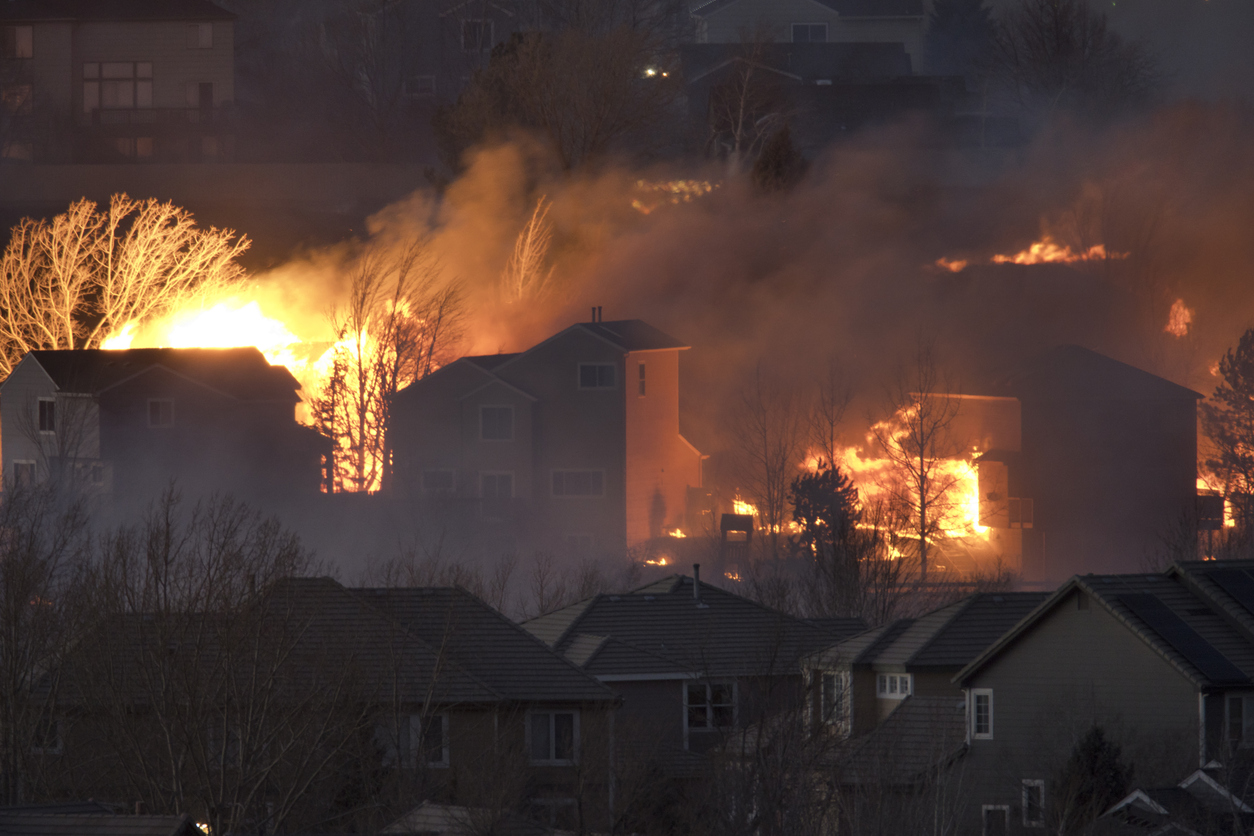
The case arose from the 2020 Glass Fire. The guest house burned, while the main residence remained standing. The policyholders alleged that smoke, soot, ash, char, volatile organic compounds, and other combustion-related substances entered the main house, affected the indoor air and building materials, and made the home uninhabitable. Federal Insurance Company, a Chubb company, disputed the claimed scope, relied on multiple experts, invoked exclusions, and eventually alleged fraud. An appraisal panel separately valued the cost to return the man-made structures to their pre-loss condition at more than $32 million and found a 36-month construction period.
The trial court’s detailed order addressed summary judgment, expert testimony, appraisal, additional living expense, code upgrades, soil work, bad faith, and fraud. It is not a final trial verdict, and it is not binding California appellate precedent. Several important issues remain for a jury. Still, it is one of the most useful recent roadmaps for policyholders, public adjusters, lawyers, and experts handling standing-home and partial-loss wildfire claims.
I read Pollock as both a significant policyholder ruling and a warning: a wildfire smoke claim succeeds when it is built as a disciplined chain of proof, not merely as a large estimate or a generalized assertion that the property is contaminated.
1. Persistent Wildfire Contamination Can Qualify as Physical Loss
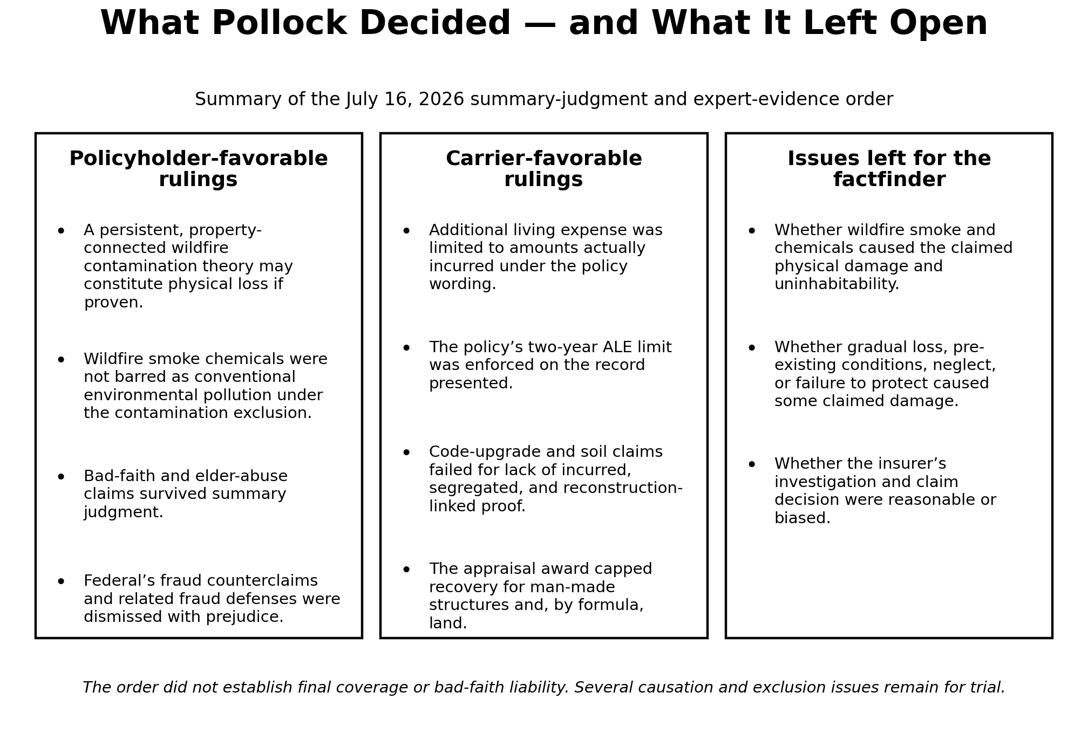
Federal argued that the policyholders’ theory failed under the California Supreme Court’s decision in Another Planet Entertainment, LLC v. Vigilant Insurance Company. The court disagreed that the claim could be eliminated as a matter of law.
The important distinction was that the policyholders did not rely solely on the abstract presence of a chemical. Their experts offered evidence that chemicals from the wildfire smoke plume affected both the air and the building materials and allegedly made the residence uninhabitable. The court held that, if the policyholders prove those facts, they can establish physical loss under Another Planet.
That is a major point for Palisades and Altadena standing-home claims. A claim should not be presented merely as:
Smoke was present, so the house must be rebuilt.
The stronger presentation is:
Wildfire combustion products entered through identified pathways, became attached to or absorbed into identified property, remained persistent, materially impaired the home’s residential function, and cannot be removed through the carrier’s proposed protocol without destructive access or replacement of affected components.
The proof should address the entire building system: HVAC equipment and ducting, attics, wall and ceiling cavities, insulation, cabinetry, unfinished wood, plaster, stone, textiles, contents, electronics, and other porous or difficult-to-access materials. Odor can be evidence, but odor alone should not carry the claim.
2. A Pollution or Contamination Exclusion Should Not Swallow Basic Fire Coverage
The policy defined pollutants broadly enough to include smoke, soot, fumes, acids, and chemicals. Federal argued that volatile organic compounds were therefore excluded pollutants. The court rejected that application of the exclusion.
Relying on MacKinnon v. Truck Insurance Exchange and related authority, the court held that the exclusion was aimed at conventional environmental pollution, not toxic substances released as byproducts of a hostile wildfire. The court recognized the common-sense problem with Federal’s position: nearly every fire produces smoke and fumes, and fire coverage would be substantially undermined if an insurer could recharacterize those ordinary fire products as excluded pollution.
This does not mean every exclusion labeled “pollution,” “contamination,” or “pollutant” is irrelevant in every wildfire case. Policy wording and causation still matter. But Pollock provides strong support for the proposition that an insurer cannot avoid fire coverage simply by changing the vocabulary from “smoke damage” to “chemical contamination.”
3. A Carrier Does Not Win Bad Faith Simply by Hiring Experts
Federal invoked California’s genuine dispute doctrine and argued that its reliance on credentialed experts made its coverage position reasonable as a matter of law. The court declined to dismiss the bad-faith claim.
The policyholders’ evidence went beyond a disagreement over scope or price. They contended that Federal conducted a biased or incomplete investigation, ignored favorable evidence, withheld data, used an improper damage standard, treated smoke as equivalent to ordinary dust, tailored the investigation to avoid finding damage, used unqualified consultants for certain opinions, misstated policy terms, and issued an inadequate coverage letter. The court found factual disputes requiring trial.
That ruling is important, but it should not be overstated. The court did not find that Federal acted in bad faith. It held that expert retention did not automatically insulate the insurer from a jury’s review of how those experts were selected, instructed, used, and reconciled with contrary evidence.
For public adjusters and policyholders, the practical lesson is to document the investigation process, not just the competing bottom-line estimates. Ask:
- What damage definition did the insurer use?
- What residential health or habitability standard did it apply?
- Which rooms, assemblies, cavities, and contents did it test?
- What analytes were included or excluded?
- Did it preserve and produce raw data?
- Did its remediation protocol address its own consultants’ findings?
- Did the insurer explain why it accepted one expert conclusion and rejected another?
A “battle of experts” may be a genuine dispute. An outcome-driven or incomplete investigation may be something different.
4. Use a Team of Experts, and Keep Each Expert in the Correct Lane
The court’s expert rulings are a practical guide to building a wildfire smoke case.
The court allowed testimony from an analytical environmental chemist concerning wildfire chemistry, chemical profiles, source analysis, soil contamination, and chemical effects on property. It allowed an industrial hygienist’s testing opinions where the relevant raw data had been produced. It also allowed a licensed architect to address how building configuration, flexible ducting, concealed spaces, inaccessible assemblies, and porous materials affected the feasibility of cleaning versus demolition and replacement.
At the same time, the court excluded or limited opinions when the expert’s qualifications or methodology did not fit the issue. An epidemiologist’s proposed “doubt science” opinion was excluded because his expertise and method did not sufficiently establish insurance-industry bias. A forensic accountant’s “red flags” reserve opinion was excluded as tangential and prejudicial. An insurance broker who had never handled claims was not permitted to testify about claims-adjustment practices.
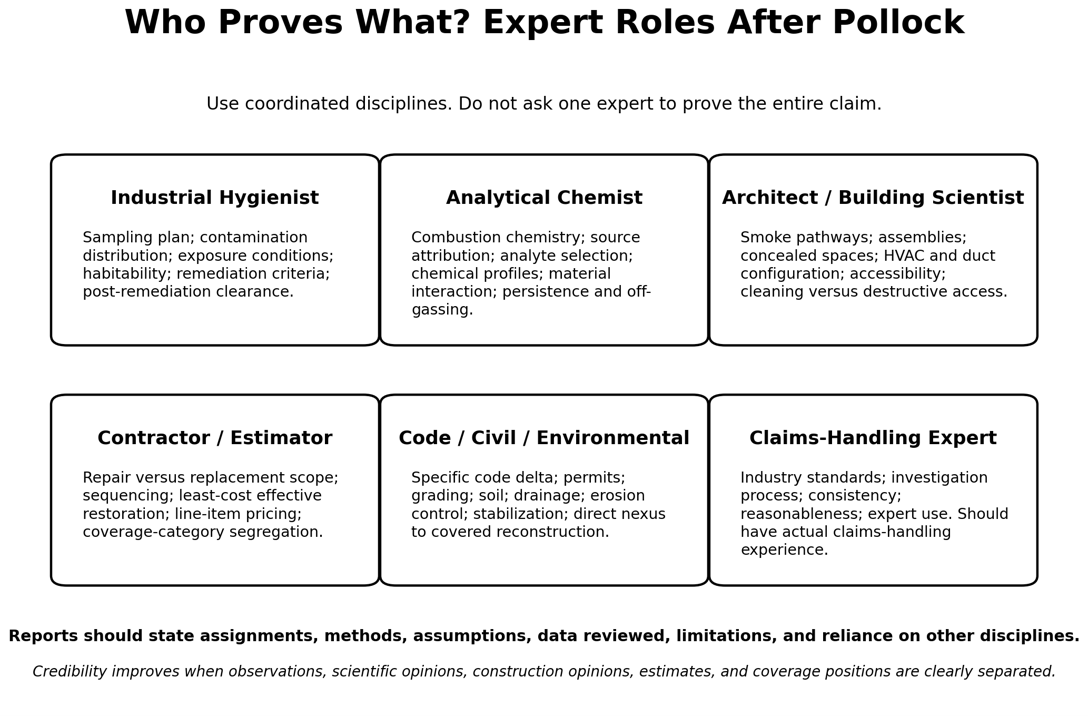
The lesson is not to search for one expert who will say everything. The better model is a coordinated team:
- An industrial hygienist addresses sampling, exposure conditions, contamination distribution, and habitability.
- An analytical chemist addresses combustion products, source attribution, chemical profiles, persistence, and material interaction.
- An architect or building scientist addresses pathways, concealed spaces, accessibility, building assemblies, and remediation feasibility.
- A contractor or estimator prices the defined repair or replacement scope.
- A code consultant identifies the specific ordinance or code requirement and the incremental cost it creates.
- A civil, geotechnical, or environmental professional ties soil, grading, drainage, erosion control, or stabilization work to the covered reconstruction.
- A claims-handling expert should have actual claims-handling experience and should address industry standards rather than offer legal conclusions.
Each report should identify the expert’s assignment, the materials reviewed, the methodology used, the assumptions made, and the opinions that belong to other disciplines.
5. Additional Living Expense Is an Incurred-Expense Claim
The policyholders sought substantial additional living expense based in part on the cost of recreating aspects of their usual standard of living, including comparable housing, furnishings, art, wine, and books. Their expert acknowledged that much of the claimed amount had not actually been incurred.
The court held that the policy covered only additional living expenses that were actually incurred. It also enforced the policy’s two-year limitation on the facts presented. The policyholders could not use estoppel or the prevention doctrine to create additional substantive coverage, and the court rejected their request for a statutory extension because they had not tied the delay to the type of reconstruction bottlenecks identified by California Insurance Code section 2060, such as permitting delays, unavailable contractors, or material shortages.
This ruling contains several practical lessons:
- A theoretical rental value or lifestyle-equivalence calculation is not a substitute for an actual lease, invoice, contract, deposit, or other financial obligation.
- Policyholders should request advances in writing rather than waiting for reimbursement after spending funds they may not have.
- Every ALE category should be supported by contemporaneous proof.
- Requests for statutory extensions should identify specific reconstruction delays beyond the insured’s control and document reasonable diligence.
- A 36-month period of restoration found in appraisal does not automatically create 36 months of ALE coverage.
For Palisades and Altadena claims, the reconstruction-delay file should be developed now. Preserve permit communications, contractor availability records, debris-removal restrictions, utility delays, material lead times, access restrictions, and other evidence showing why reconstruction could not proceed despite the policyholder’s diligence.
6. Code-Upgrade and Soil Claims Require Segregated Costs and a Reconstruction Nexus
The court granted Federal summary judgment on the claimed rebuilding-to-code and soil-replacement benefits.
For code upgrades, the policyholders did not present evidence separating ordinary reconstruction costs from the additional cost caused by a specific code or ordinance. The court also found that the claimed code costs had not been incurred because rebuilding had not begun. On that record, a general assertion that a modern rebuild must comply with current code was not enough.
For soil work, the policyholders presented evidence that soil removal was generally recommended or required by remediation guidance. But the policy’s land coverage required excavation, replacement, or stabilization to be necessary for the repair, replacement, or rebuilding of the house or another permanent structure. The court found the required link missing. Evidence that soil work was advisable for health, environmental, or landscape reasons did not establish that the work was required to reconstruct covered structures.
Public adjusters and policyholders should therefore avoid broad, undifferentiated categories such as “code upgrades” or “soil remediation.” The estimate and supporting reports should identify:
- The specific code, ordinance, permit condition, or agency requirement.
- The building component affected.
- The base cost of ordinary reconstruction.
- The incremental cost attributable only to compliance.
- Whether the cost applies at the original location or a replacement location.
- For soil or site work, why the work is necessary to demolish, repair, replace, support, access, protect, or obtain permits for a covered structure.
Pollock should not be read as eliminating statutory rights to replacement-cost or code-upgrade benefits when an insured rebuilds or purchases elsewhere. It shows that those rights still require proof that the expense is covered, necessary, and properly measured under the applicable policy and law.
7. Appraisal Can Fix the Amount Without Resolving Coverage, and the Award May Cap Recovery
The appraisal panel valued the cost to return the man-made structures to pre-loss condition at $32,122,214.15 and found a 36-month construction period. The award expressly disclaimed coverage determinations.
The court held that the panel had valued replacement cost, not actual cash value. As a result, the award placed an upper limit on recovery for the man-made structures and, through the policy’s percentage formula, on land coverage. At the same time, the appraisal did not resolve causation, exclusions, neglect, or failure to protect. Those issues remained for the court or jury.
This is a critical appraisal lesson. Before demanding or agreeing to appraisal, define:
- What property and coverage categories are included.
- What categories are excluded, such as contents, ALE, landscaping, soil, or loss of use.
- Whether the panel will state replacement cost, actual cash value, or both.
- Whether the panel will itemize by structure, room, system, or trade.
- Whether the panel will state a period of restoration.
- How the award may operate as a ceiling later.
Appraisal can be a powerful way to establish amount. It can also become a permanent limit. It should be approached as a major evidentiary proceeding, not an informal estimating conference.
8. Precise Attribution Can Defeat an Insurer’s Fraud Theory
Federal alleged that the policyholders committed fraud by presenting a large proof of loss, estimating a lengthy reconstruction period, and supposedly representing that an industrial hygienist had concluded the main house had to be demolished and rebuilt.
The court dismissed Federal’s fraud and breach-of-contract counterclaims, along with the related fraud-based affirmative defenses, with prejudice.
One reason was precise attribution. The September 2021 claim letter accurately described the industrial hygienist’s findings concerning soot, char, ash, residues, interstitial spaces, and building materials. The letter did not say that the hygienist had personally selected demolition as the remedy. The demolition-and-rebuild conclusion was presented as counsel’s conclusion based on the combined record, including a construction expert’s opinion that cleaning would not achieve full remediation.
The practical drafting rule is simple: distinguish among observation, scientific opinion, construction opinion, estimate, and coverage position. A strong claim letter might say:
The industrial hygienist identified specified residues and contaminants in specified locations. The chemist attributes specified findings to wildfire combustion. The architect concludes that affected assemblies cannot be accessed and restored through surface cleaning. The contractor prices the least-cost scope required to return the property to its pre-loss condition. Based on those findings, the policyholder contends that the policy requires the stated repair or replacement remedy.
Do not attribute a demolition opinion to an expert who did not give it. Do not present an estimate as a completed expense. Do not blur an expert’s factual findings with counsel’s legal conclusion. Precision protects credibility.
9. Mitigation and Failure-to-Protect Defenses Must Be Addressed in Real Time
The policyholders did not obtain summary judgment eliminating Federal’s gradual-loss, neglect, failure-to-protect, and outside-the-policy-period defenses. Those issues involved disputed causation and remained for trial.
This is a warning for any policyholder who declines an insurer-funded cleaning protocol. There may be sound reasons not to undertake cleaning that could destroy evidence, spread contamination, damage high-value materials, or fail to reach concealed areas. But those reasons should be documented by qualified professionals when the decision is made.
The claim file should show:
- What temporary protective measures were taken.
- Whether HVAC systems were shut down, isolated, filtered, or preserved for inspection.
- Why a proposed cleaning protocol was accepted, modified, deferred, or rejected.
- What evidence needed to be preserved before destructive work.
- Whether test cleaning was performed and what it showed.
- How the property was monitored for moisture, corrosion, deterioration, intrusion, and recontamination.
- What alternative measures were recommended to prevent additional damage.
A policyholder should not be forced into an inadequate remediation protocol. But a policyholder also should not leave the insurer an empty record from which to argue neglect.
The Larger Lesson for Palisades and Altadena Claims
Pollock rejects two common shortcuts. An insurer cannot necessarily defeat a wildfire smoke claim by calling fire byproducts “pollution,” and it cannot necessarily defeat bad faith merely by retaining experts. But the decision also rejects shortcuts on the policyholder side. A large proof of loss, a generalized contamination concern, an unincurred ALE model, an unsegregated code allowance, or a broad soil-remediation proposal is not a substitute for element-by-element proof.
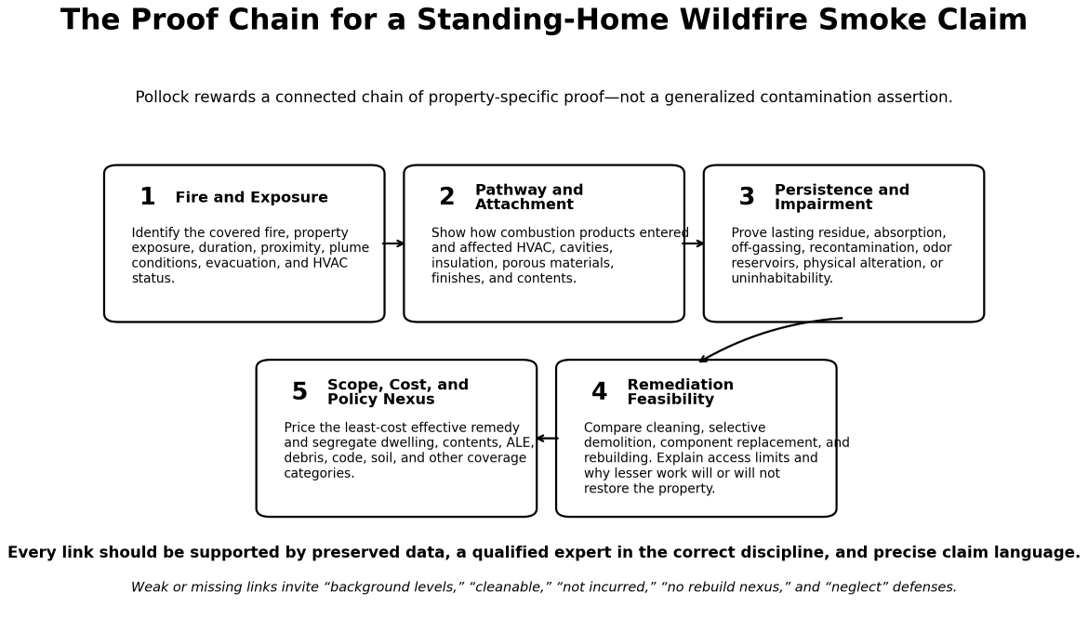
For a standing-home wildfire claim, the most persuasive presentation is a connected chain:
- Identify the covered wildfire and the property’s exposure.
- Identify the pathways by which smoke and combustion products entered or affected the property.
- Prove attachment, absorption, persistence, or other material interaction with the property.
- Prove resulting functional impairment, uninhabitability, or physical alteration.
- Compare feasible remediation alternatives.
- Select and explain the least-cost scope that will actually restore the property to its pre-loss condition.
- Price that scope by coverage category and support each additional coverage with its own policy nexus.
That is the central lesson of Pollock: science, building analysis, cost analysis, policy analysis, and careful claim communication must fit together.
Public Adjuster and Policyholder Review Checklist
Policy, Benefits, and Deadlines
[ ] Obtain the complete certified policy, declarations, endorsements, and all applicable forms.
[ ] Calendar proof-of-loss, suit-limitation, repair/replacement, ALE, appraisal, and notice deadlines.
[ ] Identify dwelling, other-structures, contents, ALE, debris-removal, ordinance-or-law, land, landscaping, and professional-fee limits or sublimits.
[ ] Request all available advances and undisputed payments in writing.
[ ] Request any ALE, replacement-cost, proof-of-loss, or reconstruction extension before the deadline and document the factual basis.
Pre-Loss Condition and Fire Exposure
[ ] Collect pre-loss photographs, videos, appraisals, inspections, maintenance records, HVAC records, and remodeling documents.
[ ] Document the fire timeline, proximity, plume or smoke exposure, evacuation period, access restrictions, and whether HVAC systems were operating.
[ ] Identify prior fires, smoke events, water losses, odors, repairs, or conditions the insurer may characterize as pre-existing.
Inspection, Sampling, and Data Preservation
[ ] Photograph and video the property before cleaning, demolition, movement of contents, or filter replacement.
[ ] Use a written sampling plan identifying locations, media, analytes, controls, and chain-of-custody procedures.
[ ] Evaluate HVAC equipment, ducts, attics, crawlspaces, cavities, insulation, porous finishes, cabinetry, contents, and other concealed or difficult-to-clean areas.
[ ] Preserve samples, filters, wipes, raw instrument files, laboratory data, photographs, field notes, calibration records, and every version of an analytical library or protocol.
[ ] Obtain the insurer’s complete testing protocol, analyte list, raw data, laboratory reports, photographs, and consultant communications to the extent obtainable.
Expert Coordination
[ ] Define each expert’s assignment and prevent experts from offering opinions outside their discipline.
[ ] Confirm that source attribution, habitability, remediation feasibility, construction scope, cost, code, soil, and claims-handling opinions are each assigned to a qualified professional.
[ ] Require each expert to identify assumptions, materials reviewed, methods, limitations, and reliance on other experts.
[ ] Confirm that the expert’s report supports the exact proposition attributed to that expert in the claim submission.
Scope, Estimate, and Coverage Nexus
[ ] Prepare a written comparison of cleaning, selective demolition, component replacement, and full reconstruction alternatives.
[ ] Explain why the proposed scope is necessary to restore the property to pre-loss condition and why lesser alternatives will or will not work.
[ ] Separate the estimate by dwelling, other structures, contents, ALE, debris removal, code upgrades, land or soil, landscaping, and other policy categories.
[ ] Identify the specific code or ordinance for every code-upgrade line item and segregate the incremental compliance cost from routine reconstruction.
[ ] Tie every soil, grading, stabilization, drainage, erosion-control, or site-work item to a covered structure, permit requirement, access need, or reconstruction activity.
[ ] Distinguish estimated costs, contracted costs, incurred costs, and paid costs.
Additional Living Expense
[ ] Maintain leases, invoices, contracts, deposits, receipts, bank records, mileage logs, utility records, storage bills, pet expenses, and other proof of actual increased expense.
[ ] Compare each claimed expense to the household’s normal pre-loss expense.
[ ] Document permit delays, contractor shortages, material shortages, debris-removal delays, utility delays, and other reconstruction circumstances beyond the insured’s control.
[ ] Do not assume an appraisal period of restoration automatically extends ALE coverage.
Mitigation and Claim Communications
[ ] Maintain a dated mitigation log identifying all protective measures and recommendations.
[ ] Obtain a written expert explanation before rejecting, delaying, or materially changing an insurer-proposed cleaning protocol.
[ ] Preserve evidence before destructive testing, cleaning, demolition, disposal, or repair.
[ ] In every claim letter, separately identify observed facts, expert findings, estimates, assumptions, and the policyholder’s coverage position.
[ ] Update the proof of loss when material information changes and explain the reason for the revision.
[ ] Ask the insurer to identify every factual, scientific, policy, and regulatory basis for any limitation or denial.
[ ] Keep the claim file organized, searchable, and indexed by date, coverage category, expert, and issue.
Appraisal and Litigation Readiness
[ ] Define the precise scope of appraisal before it begins.
[ ] Request itemization sufficient to preserve non-appraised coverage categories and later coverage arguments.
[ ] Understand whether the award may become a ceiling on recovery.
[ ] Track evidence of incomplete testing, ignored evidence, changing standards, inconsistent positions, and unexplained reliance on carrier consultants.
[ ] Obtain legal review before submitting a large sworn proof of loss, asserting a constructive total loss, rejecting major remediation, or entering appraisal.
1 Pollock v. Federal Ins. Co., No. 21-cv-09975, 2026 WL 2059133 (N.D. Cal. July 16, 2026).