A house can survive the flames and still leave its owners with serious questions about what survived inside. What entered through the windows, doors, and ventilation system? What settled on the furniture and belongings? What must be done before the family can return with confidence? Dan Veroff forwarded me a new research paper on the Eaton Fire that gives property insurance adjusters, restoration professionals, and policyholders another reason to take those questions seriously.
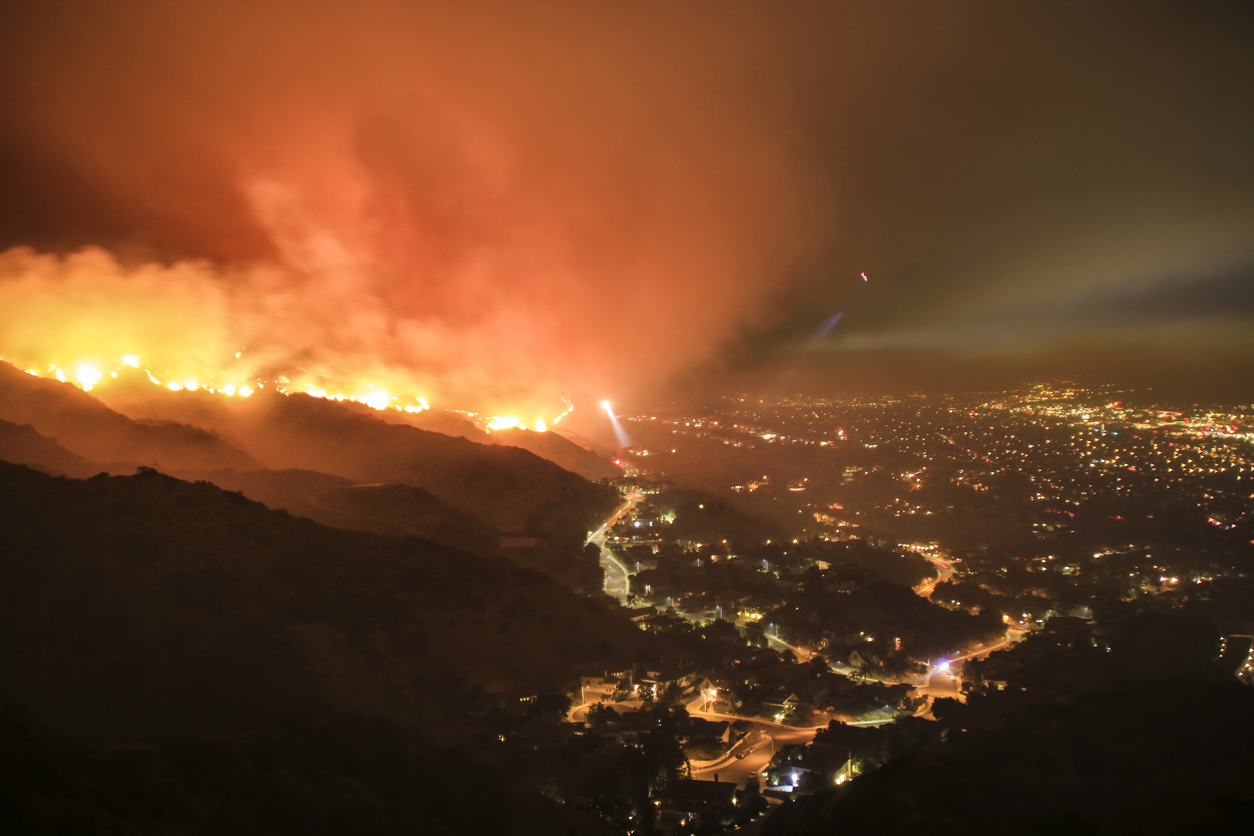
Caltech recently described a study published in Science Advances, “Fire at the boundary: Airborne toxic metals from the 2025 Los Angeles urban firestorm.” 1 According to Caltech’s account, 2 researchers found that the urban fire plume was enriched more than fiftyfold in lead, sevenfold in chlorine and bromine, and threefold in arsenic compared with wildfire smoke. These findings concern the plume’s chemical composition. They do not mean that every exposed home contains those concentrations or that the smoke was fifty times more toxic. They do show why the distinction between burning vegetation and burning neighborhoods matters.
Calling an event a “wildfire” tells us very little about what a property insurance adjuster should expect to find inside a particular house. Once the flames consume buildings, vehicles, and their contents, the investigation must account for those fuels. A familiar label should never replace understanding the actual loss.
One particularly interesting observation was that the plume’s chemical signature changed as the fire shifted from developed areas toward vegetation. Continuous measurements captured that evolution, providing evidence beyond comparing two separate fires. Caltech also cautioned that Eaton’s strong lead signature might reflect the older structures that burned in Altadena.
To me, that calls for better investigation rather than broader assumptions. Different neighborhoods may present different contamination problems. The appropriate question is whether the investigation was designed to identify the substances reasonably associated with this fire and this property. Every insurance company property insurance adjuster should ask whether the requested investigation is sufficient to identify these substances, or whether it is limited to reduce claims costs and subsequent indemnity payments.
An earlier report published by the Centers for Disease Control and Prevention, involving several of the same researchers, documented an approximately 110-fold increase in airborne lead compared with the days preceding the fires. The report also recognized that the health effects of brief, elevated lead exposures remain insufficiently understood. Scientific uncertainty deserves an honest explanation. It should not be converted into an assurance that there is nothing to investigate.
At the same time, policyholder advocates must respect the limits of the evidence. An outdoor monitoring station does not establish what entered a particular residence, what remains there, or whether a particular sofa, air-conditioning system, or building material requires replacement. Those conclusions require evidence directed to the property and the proposed restoration. Overstating a study gives the other side an unnecessary opportunity to distract from what the research actually contributes.
The practical lesson I draw is that a smoke-damage investigation should begin with questions about the nature and extent of the contamination. What are the professionals looking for? Why were those sampling locations and analytical methods selected? What would the results establish, and what would they leave unanswered? A laboratory report is useful only to the extent that its methods address the question it claims to answer.
The same discipline should apply after cleaning. If the conclusion is that the property has been restored, there should be a reasoned explanation supporting that conclusion. What was removed? How was the work evaluated? Does the verification address the contamination that prompted the work? “We cleaned it” describes an activity. The policyholder needs to understand the result.
The CDC report observed that outdoor airborne lead returned toward pre-fire levels by the evening of January 11. That finding answers a question about outdoor air at the monitoring site. It does not establish whether deposited material remained inside nearby buildings. An improving outdoor measurement cannot serve as a clearance report for somebody’s living room.
I believe the insurance industry should welcome research that helps everyone ask more precise questions. Better science can support necessary restoration and help distinguish it from work the evidence does not justify. Both outcomes require a willingness to investigate before deciding what the answer ought to be.
California’s wildfire survivors deserve that effort. A family seeking to return home should receive evidence-based conclusions, explained in language they can understand. As the science develops, our claims investigations should develop with it.
Thought For The Day
“California, with its climate, its resources and its wealth of young, aggressive, talented people, need never take second place in anything.”
— Ronald Reagan, inaugural address as California’s Governor, January 5, 1967.
1 Haroula D. Baliaka et al., “Fire at the boundary: Airborne toxic metals from the 2025 Los Angeles urban firestorm.” Sci. Adv., vol. 12, no. 44 (2026). DOI: 10.1126/sciadv.aei4455
2 Chemical Data Collected from the Eaton Fire Plume Help Characterize Urban Fires. Caltech (Oct. 28, 2026).