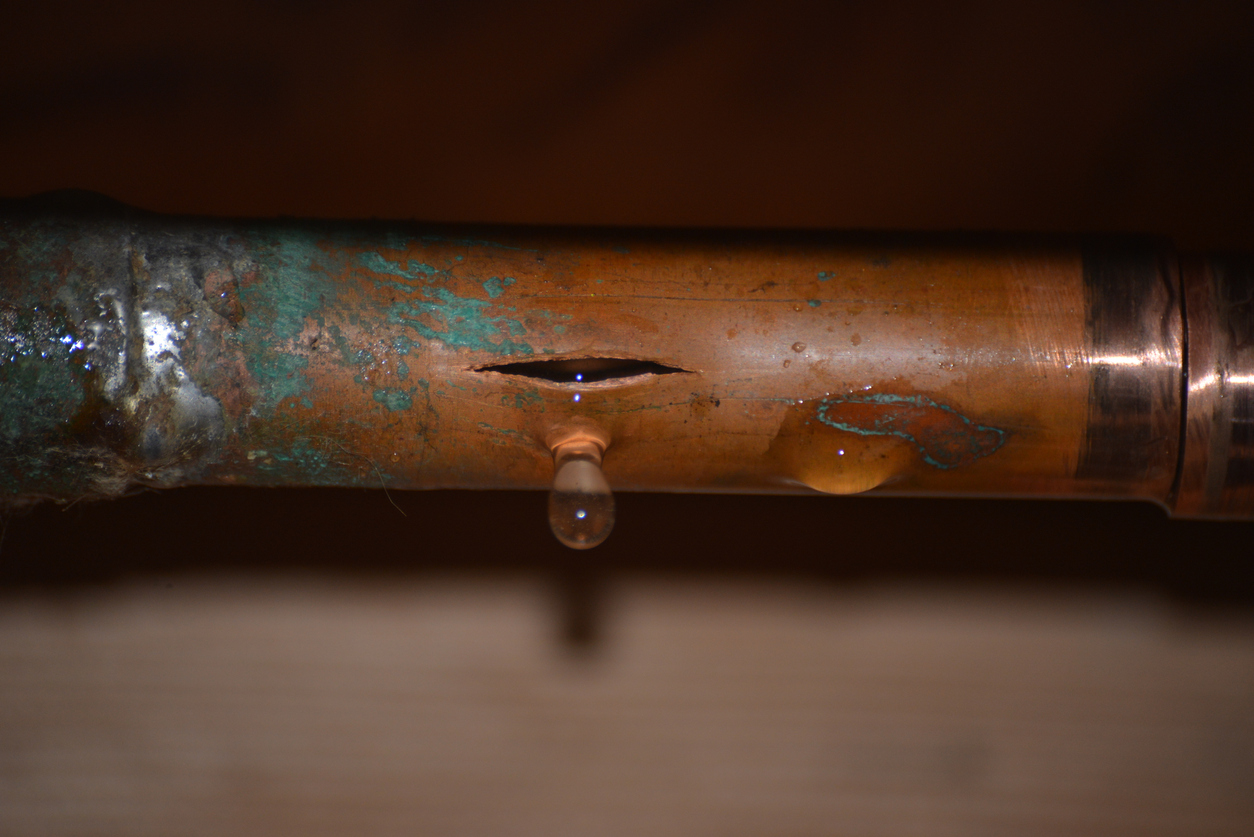
Some insurance cases read like déjà vu with a fresh caption. A recent Ninth Circuit decision involving State Farm is one of them. 1 It is a modern replay of a pattern policyholders and public adjusters have seen for years: a small plumbing leak, major destruction to a home, and State Farm standing behind a maze of water-damage exclusionary language that few consumers could ever anticipate. The court ruled for State Farm. But the real story is what the case reveals about how these exclusions have evolved into sweeping shields that are almost impossible for State Farm policyholders to overcome.
The facts were painfully familiar. A tiny hole, which was “just a little bit larger than a pen tip” formed in a pressurized hot water line. Over roughly five to eight days, the leak saturated and destroyed all subflooring and flooring in the home. This wasn’t a trickle anyone would reasonably detect. It was hidden and caused catastrophic loss.
Yet, the court concluded that because the leak developed over “a period of time,” the damage fell squarely into State Farm’s exclusion for continuous or repeated seepage or leakage from a plumbing system. The court leaned heavily on a plumber-witness who said the pipe likely failed due to “wear, tear, deterioration, and or corrosion,” which triggered another set of exclusions. Once the court accepted that framing of the facts, coverage collapsed.
This outcome echoes what I wrote in an earlier discussion of State Farm’s revised water damage exclusions. In State Farm’s Water Damage Mirage: What They Don’t Tell Policyholders, I noted how these exclusions in the State Farm policy have grown into an expansive net that entangles State Farm policyholders with almost any typical water loss unless the water bursts forth in an unmistakably dramatic fashion. The policy theoretically covers “sudden and accidental” discharge of water, but in practice, the definition of “sudden” has shrunk to the point where a homeowner practically needs a geyser in the living room for coverage to apply. That article explored how State Farm’s shift in wording was not a subtle refinement but a calculated narrowing of coverage, designed to remove the very kinds of losses most policyholders believe their homeowners insurance protects them from.
State Farm should issue a warning to its current and potential customers so that they fully understand how they will be treated with common and hidden water losses. Good faith and ethical conduct should call for this type of warning, with examples like the ones I am publishing.
The decision is a testament to how potent these water exclusions have become. The court compared the homeowners’ loss to the situations California courts have said might still qualify as covered: a dishwasher hose breaking mid-cycle, a water heater rupturing, or a toilet overflowing. In other words, the peril must be both sudden and dramatic, which are events that would be loud, obvious, and impossible for the policyholder to miss.
Real-life plumbing failures rarely announce themselves so conveniently. Homeowners do not live with thermal cameras or moisture-mapping devices strapped to their hips. They discover water damage when they smell it, step in it, or see a stain blooming across a wall or through a floor. By then, under State Farm’s reading and how it treats this situation, it is already “continuous,” already “repeated,” already excluded.
My view is that the courts are now tending to view these cases through the lens of time and physics rather than consumer expectations. But what these decisions reveal is the growing gulf between what policyholders reasonably believe they are buying and what insurers draft into sixty-page policies, dense with nuanced wording and technicalities.
What troubles me most is that exclusions like these erode the central purpose of insurance: protecting families from unforeseen losses. Nobody is going to cut behind walls or under flooring to inspect whether maintenance to the pipes is needed. Unless you were in this property claims business, no homeowner reasonably assumes that if a pipe somehow breaks from behind a wall and springs a pinhole leak, their insurer will deny the claim because the water escaped quietly rather than explosively. Nor does the average homeowner think they must detect a leak within hours to preserve coverage. Yet this is the real-world effect of State Farm’s treatment of its current policy language.
This decision is another warning. For anybody dealing with State Farm in any manner, this case reinforces the need to scrutinize State Farm policies closely and educate clients and State Farm customers early about how restrictive these water provisions have become in the eyes of State Farm claims managers and executives.
For regulators, it raises a question that deserves a hard look. Has homeowners insurance drifted too far from the safety net consumers believe they are paying for? What are you doing to require disclosure from insurers and their agents about examples such as this case? What are you doing to warn homeowners that not all “all-risk” policies are the same, and that insurers behave very differently when claims are presented?
Water losses are among the most common perils in American homes. When insurers design exclusions that devour the heart of this coverage, courts may apply the text, but consumers bear the consequence and cannot feel financially safe. As I wrote before, insurers should not hide behind clever drafting when a policyholder suffers a genuine accidental loss that is hidden from view. The law requires clarity, fairness, and good faith. The insurance industry owes no less at the point of sale.
Thought For The Day
“A good neighbor listens. And cares.
A good neighbor makes you feel safe.
A good neighbor lifts up the community.”
—State Farm Website
1 Mojica v. State Farm Gen. Ins. Co., No. 3-22-cv-01997, 2025 WL 3553034 (9th Cir. Dec. 11, 2025).