
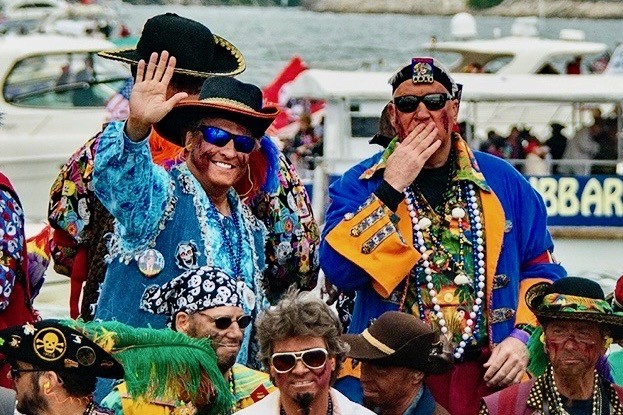
It is Gasparilla Day in Tampa. This is an annual civic ritual where otherwise respectable lawyers, doctors, judges, and business leaders, and I dress like pirates, shout “Arrr” without embarrassment, and briefly suspend the rule of law somewhere between Bayshore Boulevard and the last cannon blast. Tampa Bay will once again be “invaded,” the city will fall, and beads will be plundered with enthusiasm that would make a Lloyd’s underwriter nervous.
I have written about Gasparilla more than once over the years, partly because it is fun, and partly because piracy has an uncanny way of intersecting with insurance law. I have previously asked whether there is coverage for pirates in “Is There Coverage For Pirates? Chip Merlin and His Friends Plunder Tampa on Gasparilla Day.” I have analyzed whether invasions are covered by insurance in “Pirates Invade Tampa! Is an Invasion Covered Under a Commercial Insurance Policy.” I even wandered into the dangerous waters of theft coverage under yacht policies in “Is Theft Covered in a Yacht Policy.”
Once you start mixing pirates and insurance, it is hard to stop. This year, however, the joke has a sharper edge.
While Tampa’s pirates will be friendly, well-fed, and sponsored by corporate donors, real-world piracy has stubbornly refused to go away. Recent reports confirm that piracy is not a relic of the 1700s or something reserved for costume parades. It remains very much alive in parts of the world where ships, cargo, and crews are still vulnerable to theft, hijacking, and violence. The headlines remind us that piracy merely went on a diet for a few years and is now back at the buffet.
That contrast makes Gasparilla oddly educational. On Saturday, our pirates will fire cannons loaded with confetti instead of grapeshot. They will “seize” the city, then politely return it before dinner. Nobody will file a ransom demand. No cargo will be diverted to a shadow port. And yet, for those of us who think about risk for a living, it is a reminder that the concept of piracy has never really left insurance policies. The geography where piracy occurs has changed.
Marine insurance has always had a complicated relationship with pirates. Hull policies, cargo policies, P&I coverage, and war-risk endorsements all have their own vocabulary for theft at sea. The definitions matter. Whether an act is “piracy,” “armed robbery,” or something else entirely can determine whether coverage applies. That debate is a lot less funny when the pirates are armed, the crew is taken hostage, and the loss is measured in millions rather than beads.
Gasparilla pirates, of course, are an easier group to manage. We invade on schedule. We coordinate with law enforcement. We even have rules of conduct that disqualify us from being considered true pirates under most policies.
Still, Tampa’s annual invasion offers a useful metaphor. Every year, the city prepares. Roads close. Security is planned. Risks are anticipated and managed. That is exactly what insurers and policyholders are supposed to do with real risks—whether it is piracy in international waters, wildfire in the West, or hurricanes in Florida. The danger comes not from the threat itself, but from pretending it no longer exists.
One lesson from recent piracy reports is that complacency is expensive. When incidents decline, vigilance tends to follow. When vigilance drops, opportunists return. That cycle is familiar to anyone who practices insurance law. We see it with natural disasters, with claims handling standards, and with coverage disputes. The moment everyone assumes the problem is “over,” it has a way of reappearing and often with interest.
Outside of Tampa Bay, piracy never got the memo that it was supposed to disappear. It is still there, still evolving, and still testing the promises written into insurance policies. The fact that we can joke about pirates once a year is a privilege earned by preparation, law, and planning. These are what real-world piracy exploits when they are missing.
Thought For The Day
“Life’s pretty good, and why wouldn’t it be? I’m a pirate, after all.”
—Johnny Depp (as Captain Jack Sparrow)