Here is a question for you. If someone walked up to you on the street and asked, “Is a tornado a windstorm?” What would you say? Most people would not even hesitate. Of course it is. What kind of question is that?
That reaction is fair. Honestly, it makes sense to me. A tornado has wind. A lot of it. Violent, terrifying wind capable of relocating and demolishing homes. If that is not a windstorm, then what is?
We do this all the time with everyday questions. Is a hot dog a sandwich? Is an alligator a fish? Everyone has an instinctive answer, and usually a strong opinion to go with it. But the moment the question actually matters for something—say, a health code, a hunting regulation, or a zoning ordinance—we stop laughing and start parsing words.
But here is the thing about the law, and about life, really. The obvious answer is not always the complete answer. Sometimes the questions that seem the easiest are the ones most worth sitting with for a while.
On February 13, 2026, the Texas Supreme Court delivered its opinion in Privilege Underwriters Reciprocal Exchange v. Mankoff. 1 The question before the court was straightforward enough: Does a Windstorm or Hail deductible in a homeowners insurance policy apply to damage caused by a tornado, when the policy never bothers to define the word “windstorm”?
The court said yes. A tornado is a windstorm. Case closed. But was it really that simple?
The Story of a Family and an $87,156 Question
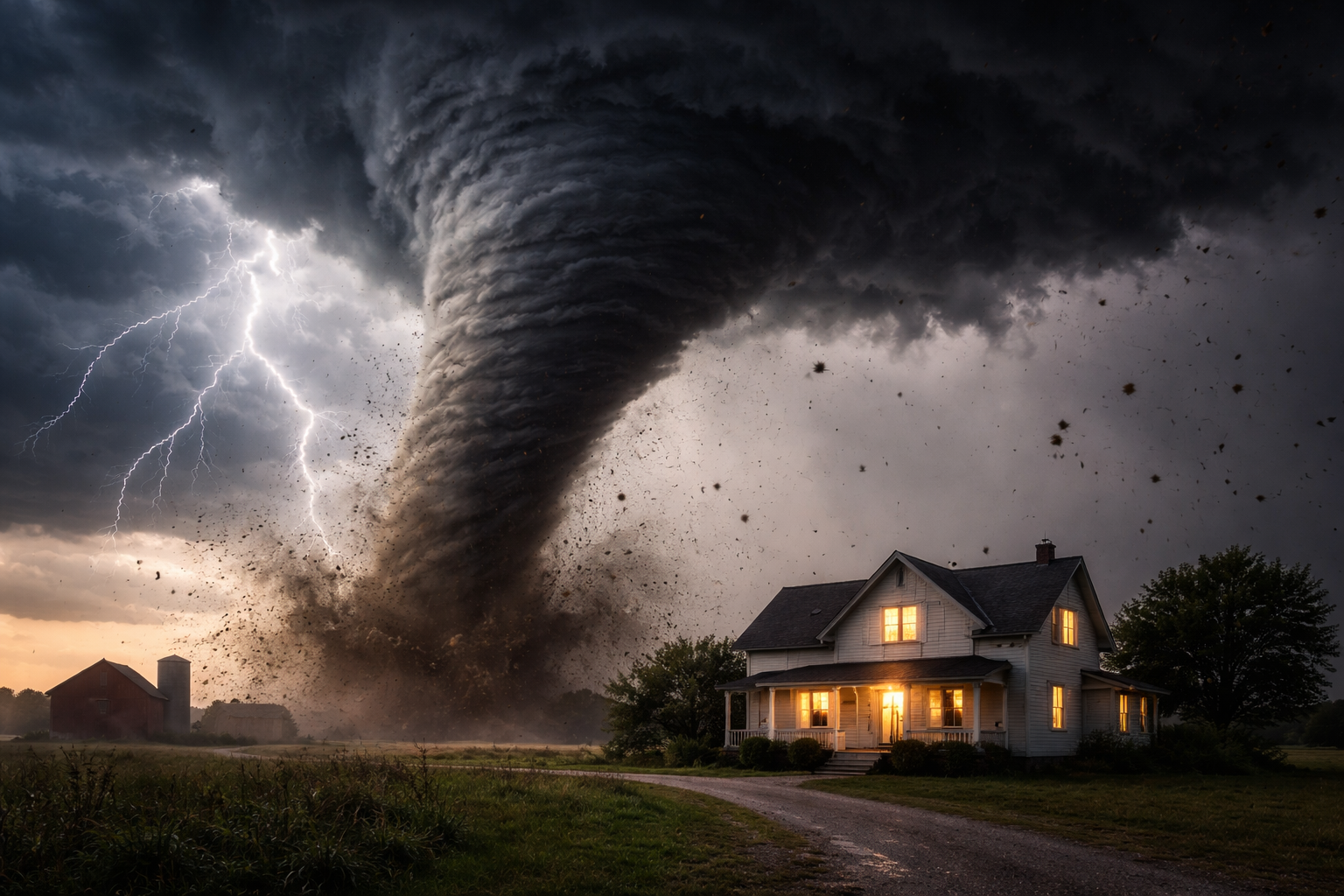
In 2019, a tornado tore through the Mankoff family’s home. It was the kind of storm that changes everything in a matter of seconds. The kind you see on the news and think, thank God that was not us (until one day it is).
The Mankoffs had insurance. They did what you are supposed to do. They filed their claim. The damages totaled over $748,000. Their insurer, Privilege Underwriters Reciprocal Exchange (“PURE”), paid a portion of that claim. But there was a catch. PURE said the tornado was a “windstorm,” and because of that, the claim was subject to a separate “Windstorm or Hail” deductible of $87,156.
Think about that number for a moment. Eighty-seven thousand dollars. That is not a rounding error. That is a life-altering sum for most families. And the entire dispute came down to one word that the insurance company never defined in the policy: windstorm.
What the Dictionaries Say (And What They Do Not)
The Texas Supreme Court did what courts typically do when a policy does not define a term: it turned to the dictionaries.
Merriam-Webster defines “windstorm” as “a storm marked by high wind with little or no precipitation.” The American Heritage Dictionary says it is “[a] storm with high winds or violent gusts but little or no rain.” Webster’s New World College Dictionary and the Collins English Dictionary say essentially the same thing.
Catch that phrase? Little or no precipitation. Every major dictionary uses some version of it.
Now look at how dictionaries define “tornado.” Merriam-Webster calls it “a violent destructive whirling wind accompanied by a funnel-shaped cloud …” The American Heritage Dictionary describes it as “a violently rotating column of air extending from a cumulonimbus cloud to the ground ….”
A cumulonimbus cloud? That is a thunderstorm cloud. The kind of cloud that produces, among other things, heavy precipitation.
The court acknowledged this tension but concluded that a tornado is a windstorm “in and of itself,” regardless of whether the broader weather event surrounding it involves precipitation. In other words, the tornado is just the wind part. Everything else happening around it—the rain, the hail, the thunderstorm—does not change what the tornado is at its core.
It is a reasonable position. But it is not the only reasonable position, and that is exactly the point the Mankoffs tried to make.
The Appellate Court Saw It Differently
Before this case reached the Texas Supreme Court, it went through the Fifth District Court of Appeals in Dallas. A divided panel reversed the trial court and sided with the Mankoffs. To be clear, the appellate court did not rule that a tornado was not a windstorm. The majority concluded that the Windstorm and Hail Deductible was ambiguous because the term “windstorm” was undefined in the policy and subject to more than one reasonable meaning.
Let us pause on that. These are not first-year law students debating a hypothetical. This is an appellate court—some of the brightest legal minds—and the majority found that the Mankoffs’ interpretation was reasonable. They looked at the same dictionaries, statutes, and case law and reached a different conclusion than the Supreme Court ultimately did.
Does the fact that intelligent, experienced jurists at the appellate level sided with the policyholders tell us something? At a minimum, it tells us that the policy language could be read more than one way. And in insurance law, when language can be read more than one way, there is a long-standing rule: you construe the ambiguity in favor of the policyholder.
Why the Rules Exist: Contracts of Adhesion
Insurance policies are not like other contracts. When you buy a car, you can kick the tires. When you rent an apartment, you can read the lease before you sign. But when you buy an insurance policy, the terms are written entirely by the insurance company. The policyholder rarely, if ever, has the ability to negotiate a single word.
In fact, many policyholders never even see the policy until after they have already purchased it. Think about that. Name another product you buy without being able to read the terms first. A gym membership? Even those let you read the contract. A cell phone plan? You can pull up the terms online. But insurance? You are often trusting the agent’s summary and hoping for the best.
That is exactly why courts have long held that insurance policies are contracts of adhesion and that ambiguous terms must be construed in favor of the insured even if the construction urged by the insurer appears to be more reasonable or a more accurate reflection of the parties’ intent. The reasoning is simple: if the insurance company wanted the word to mean something specific, it had every opportunity to say so. It wrote the policy. It chose the words. And if those words can reasonably mean more than one thing, the policyholder should not bear the cost of the insurer’s lack of clarity.
A Question That Has Been Around for Decades
This is not a new debate. The question of what constitutes a “windstorm” when the insurer leaves the term undefined has been bouncing around courts across the country for a long time.
For example, in 2010, the Supreme Court of Rhode Island tackled a similar question in Bliss Mine Road Condominium Association v. Nationwide Property & Casualty Insurance Company. 2 There, a powerful storm with wind gusts up to seventy-five miles per hour, along with rain, sleet, and snow, damaged a condominium. The insurer applied a windstorm deductible. The policyholder said the storm was not a windstorm because it was accompanied by significant precipitation. Remember the definitions above—windstorms are generally defined as having little to no precipitation.
The Rhode Island Supreme Court agreed with the policyholder. It held that the term windstorm, as undefined and used in the policy, was reasonably susceptible to more than one meaning, and that it was therefore ambiguous. The court looked at the dictionary definitions, the same ones that say “little or no precipitation,” and found them broad enough to support multiple interpretations.
The point is not that any one of these cases should have come out a particular way. The point is that for decades, courts have wrestled with this question. States are genuinely split. One Ohio court 3 described the situation as courts being in “hopeless conflict” when trying to define “windstorm” where the policy fails to do so. If the answer were truly obvious, would the conflict exist at all?
The Precipitation Problem
What may have been fatal to the Mankoffs’ argument in this particular case was the specific weather event that hit their home. The tornado struck, and it “likely” rained for approximately two minutes afterward. Two minutes. Little to no precipitation.
That specific set of facts fit neatly within the generally accepted dictionary definition of a windstorm—high winds with little or no precipitation. Perhaps the court pointed to the dictionaries and thought, this tornado, on these facts, satisfies the definition.
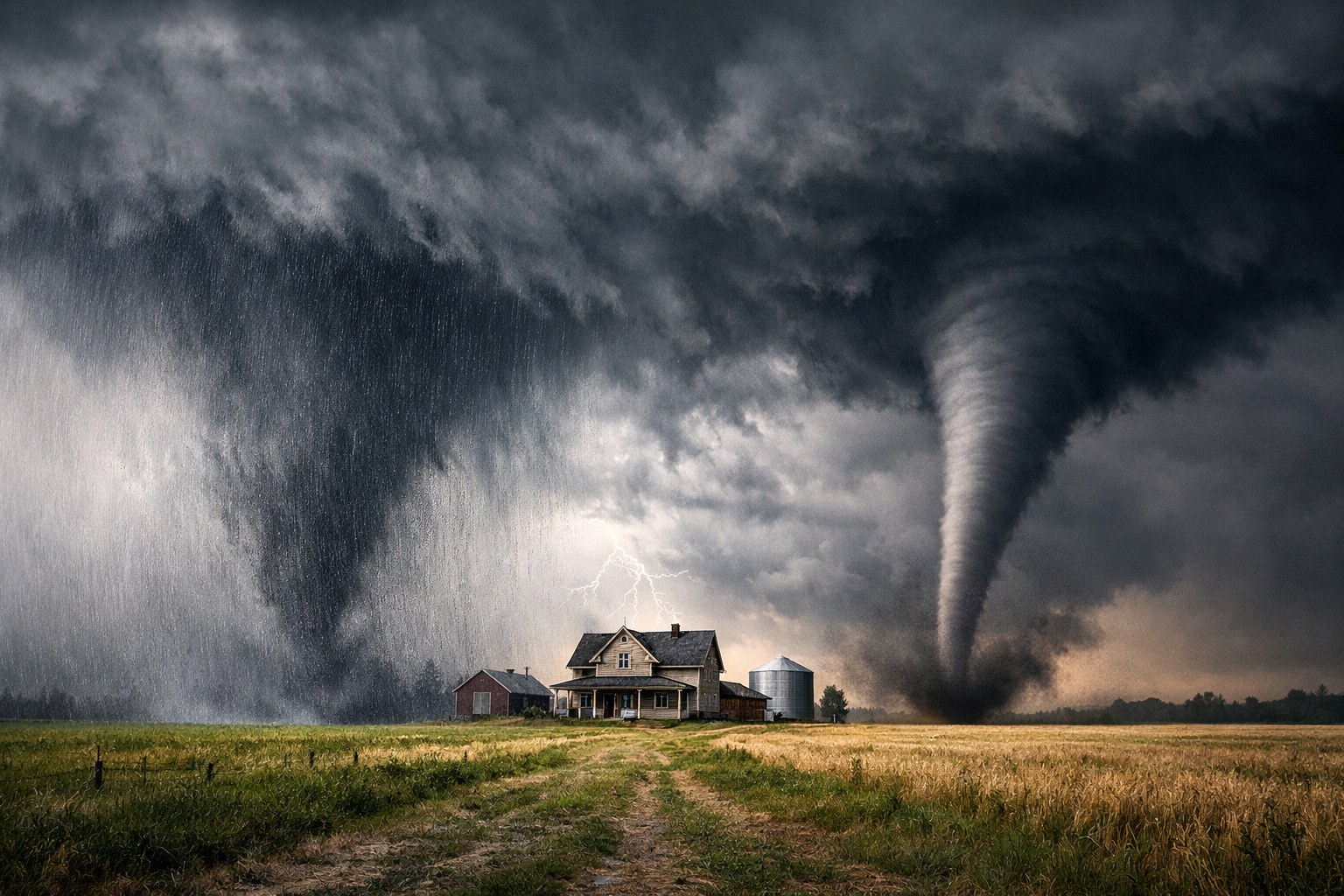
But what if the facts had been different? What if the tornado had been accompanied by heavy rain, dumping inches of water? Would the court have reached the same conclusion?
We cannot know for certain. But the court itself seemed to leave that door slightly ajar, noting that “some tornadoes occur amidst broader weather events that may not be classified as windstorms because of significant precipitation.” It then drew a distinction between the tornado itself and the broader weather system—treating the tornado as a windstorm “in and of itself,” separate from whatever else is going on around it.
That is an interesting intellectual exercise, but one could ask: when a family’s home is destroyed by a tornado that forms inside a thunderstorm, how practical is it to isolate the tornado from its parent storm? In the real world, they are not separate events. They are one terrifying experience.
Why Not Just Define It?
Arguments over whether a hot dog is a sandwich are fun for late‑night talk shows. Debates about whether an alligator is really a fish might make for a good bar bet. But when the question is whether a tornado is a windstorm and the answer decides whether a family is out $87,156, why leave that to a semantic fight after the fact? Why leave that kind of question up for debate when a family’s livelihood is on the line?
There is a question that lingers beneath all of this, and it might be the most important one: Why does the insurance company not simply define “windstorm” in the policy?
Insurance companies draft these policies. They employ teams of lawyers and actuaries. They have seen this question litigated in state after state over a period of decades. They know the dictionaries. They know about Bliss Mine. They know about the “hopeless conflict” among jurisdictions. They set separate deductibles for windstorm damage—meaning they treat windstorm losses differently from other losses.
And if the insurance company wants the windstorm deductible to apply to tornadoes, how hard would it be to write: “For purposes of this policy, ‘windstorm’ includes but is not limited to tornadoes, hurricanes, and derechos”? A single sentence. A few seconds of drafting time. Problem solved. Would this be asking too much? I don’t think so. Most policies define what “water” means.
For reasons I cannot offer you, they leave the term undefined. And then, when a family’s home is destroyed, and the family files a claim, the insurer says, “Well, obviously, a tornado is a windstorm.”
Maybe it is obvious. But if it were truly that obvious, the courts of multiple states would not have spent decades disagreeing about it.
A Society That Allows the Question
Here is what I believe, and I will leave you with this. We are blessed to live in a society where questions like this can be asked. Where a family that has lost their home can challenge a multi-billion-dollar insurance company in court and say, “We do not think that word means what you say it means.” Where an appellate court can look at the same word and reach a conclusion different from the trial court. Where the highest court in the state can take the case and settle the matter—even if reasonable minds disagree about the outcome.
The Texas Supreme Court has spoken: “we hold that the common, ordinary meaning of ‘windstorm’ in an insurance policy unambiguously includes a tornado.”
But the conversation does not end with one opinion. Other states have reached different conclusions. The question will come up again, perhaps next time with a tornado wrapped in a deluge of rain, or with a policy using slightly different language. And when it does, the same fundamental issue will be there: When an insurance company writes a policy, leaves a critical term undefined, and then interprets that term in a way that costs a family tens of thousands of dollars, who should bear the consequences of that ambiguity?
The answer, for now, depends on where you live and what happened on the day the storm hit your home. But the question itself is one worth asking. It is one worth thinking about. And it is one that is far less obvious than it appears at first glance. My colleague, Larry Bache, wrote about this opinion in, Plain Meaning Prevails: What the Texas Supreme Court’s Windstorm Ruling Means for Policyholders.
Bliss Mine Rd. Condo. Ass’n v. Nationwide Prop. & Cas. Ins. Co., 11 A.3d 1078 (R.I. 2010).
Yunker v. Republic-Franklin Ins. Co., 442 N.E. 2d 108, 111 (Ohio 1982) (The only consensus is that the cases are in hopeless conflict in our research of other jurisdictions when trying to judicially define the term windstorm, which is not defined by the policy).