
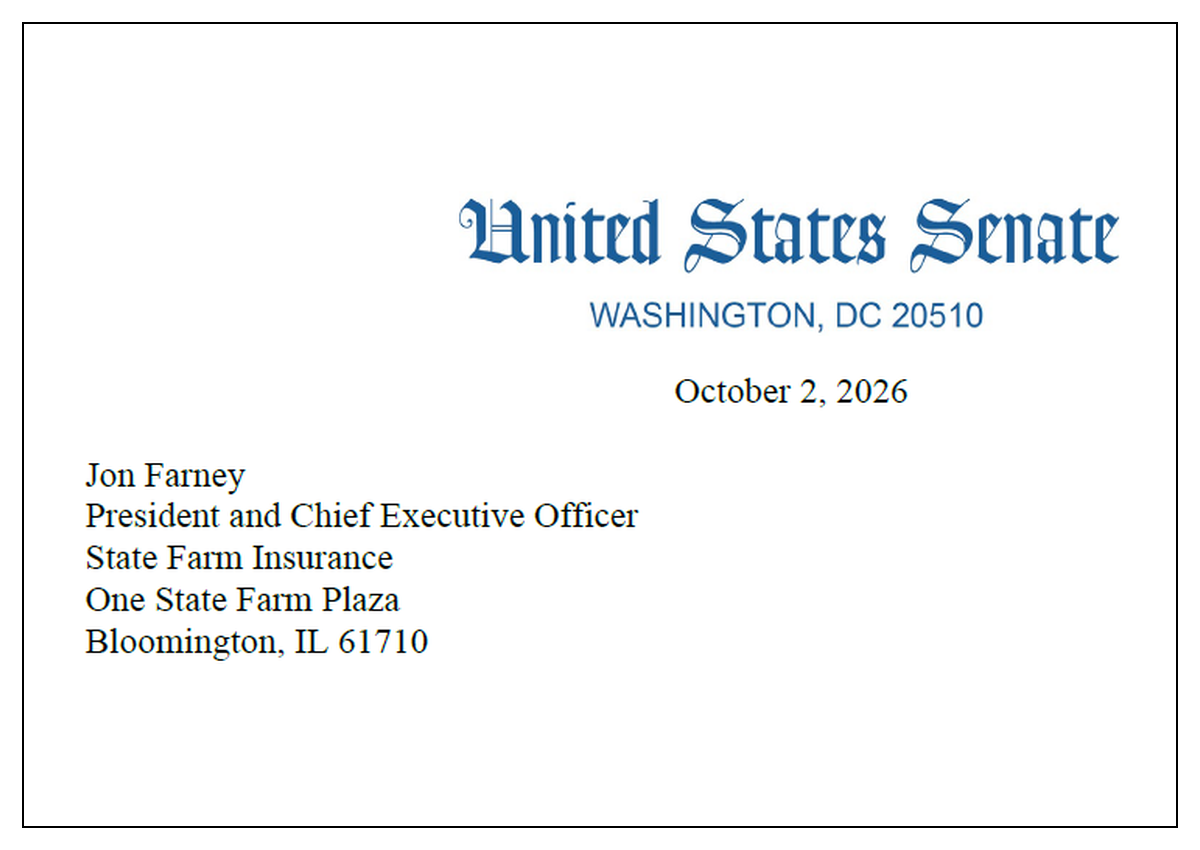
On October 2, 2026, Senators Josh Hawley and Elizabeth Warren sent a letter to State Farm raising a question that should concern everyone in the insurance business: Are consumers paying far more for homeowners and auto insurance while becoming less likely to receive anything when they actually make a claim? Their letter cites reporting that major insurers collectively closed 44 percent of resolved homeowners claims without payment last year, compared with 36 percent roughly a decade ago. They point to a similar increase in auto claims ending without payment.
Those statistics certainly do not prove wrongdoing. Claims can properly close without payment because damage falls below a deductible, an exclusion applies, or the claim is withdrawn. Hawley and Warren seem to understand that distinction because they are asking State Farm to provide ten years of claims data broken down by peril and by the specific reason no payment was made. They also want to know how often policyholders challenged those decisions and how frequently State Farm later reversed itself or made a payment.
The requested information could tell us far more than simple complaint statistics. If the rise in zero payment claims comes mostly from higher deductibles, that tells one story. If formal denials have significantly increased, that tells another. If many initially denied claims later result in payment after somebody fights back, regulators should want to know why the original decisions were wrong.
The part of the letter that caught my attention most concerns employee compensation and performance incentives. Hawley and Warren ask State Farm to describe compensation, bonuses, performance evaluations, and other incentive programs tied to claim payments, severity, loss ratios, settlement amounts, claims closed without payment, or denial rates. That gets much closer to understanding how a claims organization actually operates.
There is nothing improper about an insurance company measuring claims performance. Every claims organization needs standards for accuracy, speed, customer service, fraud control, and efficiency. But anyone who has managed people knows that employees quickly learn what really matters by looking at the numbers on their scorecards and the measurements affecting their compensation. If an adjuster hears speeches about customer service but is financially rewarded for reducing severity or leakage, the internal incentive may matter more than the public message.
I hope this inquiry eventually moves from descriptions to documents. I would want to see the actual claims dashboards, bonus formulas, leakage reports, severity goals, manager scorecards, adjuster evaluations, catastrophe performance measurements, and executive objectives. Those records could show whether prompt, full payment is genuinely measured alongside cost control, or whether one side of that equation receives far more attention.
Artificial intelligence is the second area that deserves close examination. Hawley and Warren specifically ask about State Farm’s use of artificial intelligence, predictive analytics, and automated tools in homeowners and automobile claims, as well as the safeguards intended to assure fair and accurate decisions. AI could be enormously beneficial to claims organizations, but the important question is what the technology is programmed and encouraged to accomplish.
Does an algorithm help identify damage and move claims toward faster payment, or does it primarily identify opportunities to reduce estimated severity? Does it flag claims for investigation? Does it recommend settlement amounts? Does it compare one adjuster’s payments against peers? Can adjusters freely override automated recommendations, and if they do, does that affect their performance evaluations? AI can make good claims practices more efficient, but it can also scale questionable management practices across thousands of claims almost instantly.
The senators are also asking whether State Farm will publicly release annual claims data much like mortgage lenders report lending information. That could be one of the most important ideas in the letter. Imagine consumers being able to compare insurers by the percentage of claims paid, claims closed without payment, decisions reversed after disputes, and average time to first and final payment. Consumers might finally be able to compare insurance companies by how they perform after a loss rather than simply by premium price and advertising.
Insurance is a unique product because we pay now for a promise that may never have to be performed. The true test comes when the hurricane tears off the roof, the fire destroys the home, or the automobile accident happens. At that point, the policyholder has already performed by paying premiums. The question is whether the insurer performs its side of the bargain fully and promptly.
Hawley and Warren are asking questions worth answering. But the most important answers will probably not be found in polished descriptions of claims philosophy. They will be found in the internal measurements, compensation systems, artificial intelligence tools, management instructions, and data showing what actually happens to policyholders after they make a claim.
Thought For The Day
“This isn’t charity that we’re talking about. They turn to their insurance companies because they pay premiums to those insurance companies. It’s a contract.”
—Josh Hawley