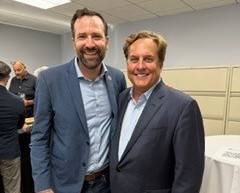
State Senator Ben Allen and Chip Merlin at Merlin Law Group’s San Francisco office on September 10, 2026.
On September 10, Merlin Law Group hosted California State Senator Ben Allen at our San Francisco office. I have spent my professional life studying insurance, litigating insurance claims, teaching insurance law, and listening to insurance executives, regulators, consumer advocates, public adjusters, lawyers, and politicians explain what is right and often wrong with the insurance marketplace. Allen’s discussion was the most sophisticated and high-level conversation about insurance and its modern challenges that I have heard from a politician running for elected office.
What struck me most was what he did not do. He did not bash insurance companies to win easy applause. That is a popular political sport, especially when premiums are increasing, policies are being nonrenewed, and policyholders are fighting over delayed or denied claims. There are certainly insurers and claims practices that deserve forceful criticism. I have made a career calling them out. But blaming every problem on insurance companies is not a plan. It is often a confession that the speaker does not fully understand how insurance works.
California’s insurance crisis is not simple. Climate-driven catastrophe risk, accumulated development in wildfire-prone areas, escalating construction costs, reinsurance expenses, catastrophe models, rate regulation, solvency requirements, inadequate mitigation, claims practices, and an overburdened FAIR Plan are all connected. Pull one lever carelessly, and another part of the system can break. Former Insurance Commissioner John Garamendi has called the position the “second-hardest job in the state behind the governor” because it requires complex, detailed regulatory work.
California needs an insurance commissioner who understands two truths at once. Insurance companies must be permitted to operate in a financially sound marketplace where rates reasonably reflect risk. They must also be held accountable when they wrongfully delay claims, conceal the basis of decisions, rely on inaccurate property information, or fail to comply with California law. Being unwilling to vilify insurers is not the same as being unwilling to regulate them. A serious regulator must be able to sit across the table from an insurance executive, understand the numbers, challenge the assumptions, and impose consequences when the company breaks the rules.
Allen’s legislative record shows that this is more than a thoughtful campaign presentation. Following the devastating Los Angeles wildfires, he authored Senate Bill 495, which Governor Gavin Newsom signed in 2025. The law requires insurers, following a covered total loss of a furnished primary residence arising from a declared emergency, to offer at least 60 percent of the policyholder’s personal-property coverage, up to $350,000, without first forcing the survivor to create a detailed inventory of everything that burned. It also gives policyholders at least 100 days to submit proof of loss and requires major admitted insurers to report reinsurance and catastrophe-model information to the Department of Insurance.
Anybody who has represented a family after its home burned knows how meaningful that reform is. Imagine losing your home, your photographs, your clothing, your furniture, and nearly every ordinary object accumulated over a lifetime, then being told to sit down and list each item before receiving the money needed to rebuild your life. SB 495 does not eliminate every inventory dispute or guarantee payment of the full contents limit. It does, however, move substantial money to disaster survivors when they need it most. That is practical consumer protection rather than a slogan.
Allen has continued that work in 2026. SB 1301, filed by Senator Allen and sponsored by Consumer Watchdog and the Eaton Fire Survivors Network, would require insurers to provide detailed, plain-language reasons for residential nonrenewals, disclose the property information and wildfire-risk factors on which they relied, allow policyholders to challenge inaccurate information, and provide an opportunity to correct remediable conditions and keep their coverage. It would also prohibit nonrenewal based solely on certain unpaid, uncovered, or below-deductible claims. The Legislature passed it, and it is now awaiting action by the governor.
His SB 1209 addresses an enforcement problem that should concern every policyholder. When the Department of Insurance examines a company and finds violations, identifying the wrongdoing should not be the end of the process. The bill requires corrective action and authorizes penalties of up to $20,000 for each category of failure when an insurer does not fix identified violations. The measure preserves notice, a hearing, and judicial review. In other words, it gives the regulator sharper teeth without throwing due process overboard. It has also passed the Legislature and is before the governor.
Allen is a coauthor of SB 877, authored by Senator Sasha Pérez, which would require insurers to provide policyholders with preliminary and final valuation, measurement, and loss-adjustment calculations. Those documents matter. Policyholders cannot meaningfully challenge a loss estimate if insurers will not show their work. Allen also authored SB 894, now before the governor, to establish a financing program for home hardening, defensible space, and smoke-mitigation improvements. The program will still require legislative funding, but the concept is sound: if California expects property owners to reduce wildfire risk, it must help make those improvements financially possible.
His broader climate record matters because the insurance commissioner cannot regulate wildfire out of existence. Allen authored the legislation that placed Proposition 4, California’s $4 billion Resilience Bond, before the voters. The initial allocations included approximately $400 million for wildfire resilience, brush clearance, home hardening, and emerging technologies. Insurance affordability will never be solved solely inside a rate filing. California must reduce the frequency and severity of loss if it wants insurers to compete for business in vulnerable communities.
Allen’s stated insurance philosophy supports modernizing rate review so filings are decided in months rather than years, while retaining the core consumer protections of Proposition 103. He supports responsible use of forward-looking catastrophe models, but with transparency and regulatory oversight. He would expand the Department of Insurance’s on-the-ground claims assistance after disasters, require better reporting about delayed and outstanding claims, increase scrutiny of claim denials, and appoint a consumer advocate within the Department. He also recognizes that the FAIR Plan should remain a temporary insurer of last resort, not become California’s default property insurer.
There is a clear distinction between the candidates in Allen’s race against former San Francisco Supervisor Jane Kim. Kim is a capable advocate whose frustration with increasing rates, nonrenewals, and insurance-company claims conduct is shared by many Californians. Her signature proposal, however, is a state-run “Natural Disaster Insurance for All” authority funded with a portion of premiums now paid to private insurers. The name is appealing, but the proposal raises enormous unanswered questions about capitalization, reinsurance, assessments, pricing, and who ultimately bears the risk after a catastrophic year. Consumer Watchdog President Jamie Court has warned that such a program could require tens of billions of dollars in startup capital and that one enormous catastrophe could wipe out the fund. California cannot afford to confuse a compelling campaign phrase with a completed insurance plan.
Allen is offering a less theatrical but far more workable approach: stabilize the admitted market, increase competition, reduce physical risk, improve transparency, enforce claims laws, reform nonrenewal practices, and create a realistic path for hardened homes and communities to return from the FAIR Plan to private coverage. That approach will not produce instant premium reductions, and Allen is responsible enough not to pretend otherwise. It offers a credible direction for restoring both availability and affordability over time.
Independent organizations examining this race have reached much the same conclusion. The Consumer Federation of California interviewed the six leading primary candidates and selected Allen as the best choice to lead the Department. He has also been endorsed by California Professional Firefighters, the Sierra Club, California Environmental Voters, and the California Democratic Party. The San Francisco Chronicle, the Orange County Register, and the East Bay Times and affiliated Bay Area editorial board have endorsed him as well. That is an unusually broad collection of consumer, environmental, public-safety, liberal, and conservative support.
To be fair, Allen is not a career insurance regulator, actuary, or insurance executive. His most substantial property-insurance legislative work is concentrated in the period following the 2025 fires, and several of his most important 2026 bills still require the governor’s signature. Two of his more ambitious proposals involving land-use planning and regional wildfire partnerships stalled in the Legislature.
But the commissioner’s job is not merely to know insurance terminology. It is to lead a large regulatory agency, understand competing economic and consumer interests, work with the Legislature, and make difficult decisions that affect coverage availability for nearly 40 million Californians. Allen has served in the Senate since 2014, chaired committees overseeing complicated regulated systems, authored more than 90 laws, and repeatedly demonstrated an ability to bring adverse interests together without losing sight of the public purpose.
Our firm hosted Ben Allen, and I had the opportunity to hear him directly. That experience influenced my judgment, which is why I am disclosing it. But my support is not based simply on a good meeting or a photograph of the two of us. It rests on what he said, what he has done, the legislation he has moved, the positions he has taken, and the alternatives in this race.
California does not need an insurance commissioner who can deliver outrage on cue. It needs one who understands how capital, catastrophe models, reinsurance, rates, land use, mitigation, claims handling, consumer protection, and solvency fit together. Californians need an insurance commissioner who never forgets why insurance exists in the first place: to provide financial recovery when disaster strikes. Ben Allen understands that responsibility. He has earned my support, and I believe he should be California’s next insurance commissioner.
Thought For The Afternoon
“Explanations exist; they have existed for all time; there is always a well-known solution to every human problem—neat, plausible, and wrong.” — H.L. Mencken, “The Divine Afflatus,” Prejudices: Second Series (1920)