
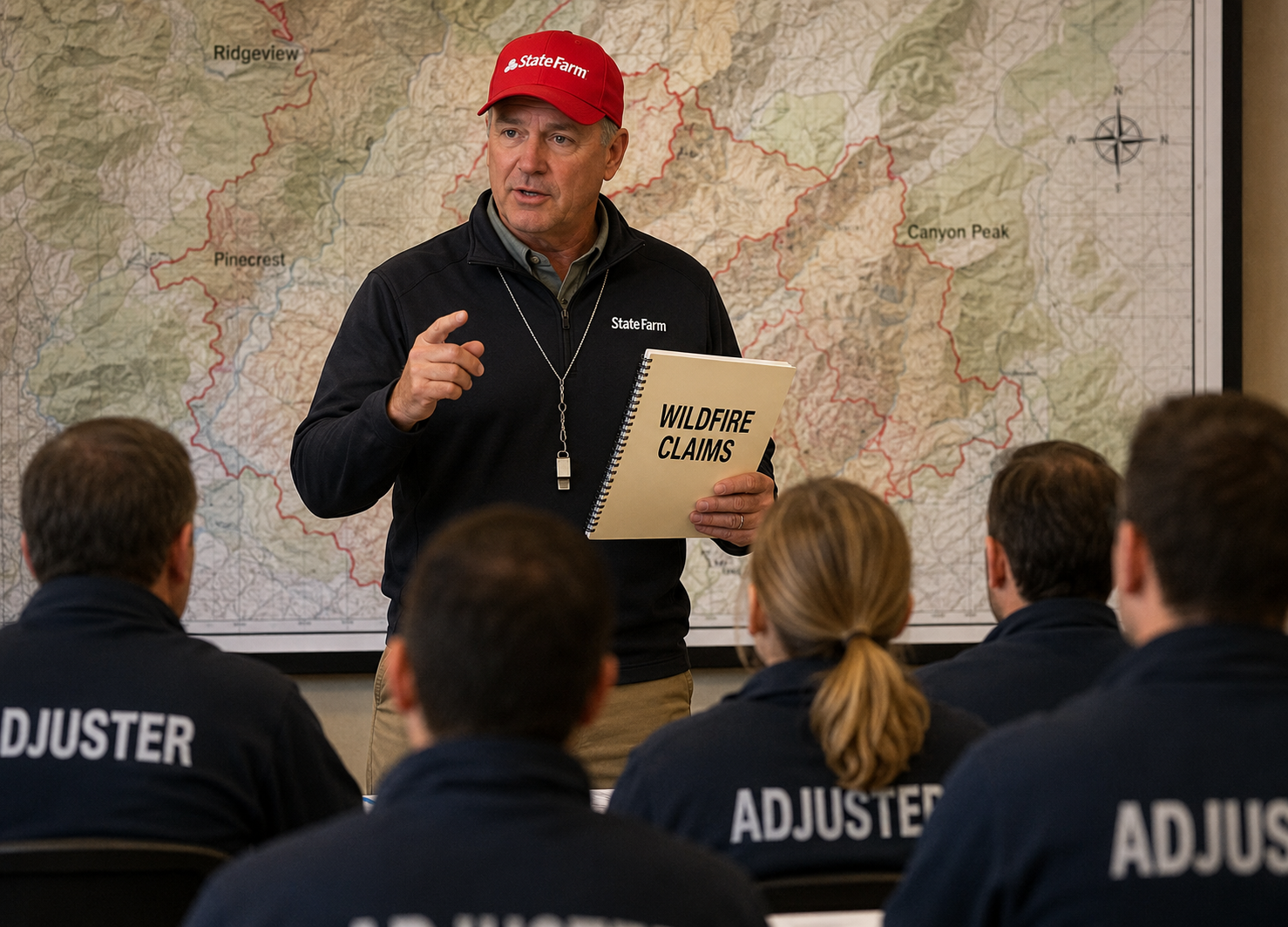
This is the first of a two-part series examining what State Farm’s internal claims materials may mean for litigation arising from the Los Angeles, Eaton, and Palisades wildfires of 2025.
This first article focuses on the claims-handling and valuation rules that may govern wildfire losses, especially smoke, soot, ash, personal property, cleaning, replacement, debris removal, code upgrades, and increased dwelling coverage.
The second article will examine the discovery required to determine what State Farm actually told its adjusters, managers, industrial hygienists, environmental consultants, remediation contractors, and estimating personnel to do. It will also address how policyholders can determine whether an individual underpayment was merely a mistake or the predictable result of a larger claims process.
The cause and origin of these wildfires are not the principal insurance dispute. Nobody needs an expert to determine whether the Eaton or Palisades fire caused widespread smoke and ash conditions throughout nearby communities.
The insurance fight is over something different: What did the smoke, soot, and ash do to each property, what must be cleaned, what must be removed, what can safely remain, and what will it cost to restore the property to its pre-loss condition? This fight is more of a scope and valuation dispute. State Farm’s internal Operation Guides may provide an important roadmap for understanding it.
The California Department of Insurance Investigation Is Important, But Civil Litigation May Go Deeper
The California Department of Insurance conducted an expedited market conduct examination of State Farm General’s handling of claims arising from the January 2025 wildfires. The Department reports that it reviewed 220 claims and identified 398 alleged violations involving 114 claims, along with 34 additional alleged violations arising from consumer complaints.
The Department has now filed an Accusation and Order to Show Cause, beginning a formal administrative proceeding in which State Farm can contest those allegations. I previously discussed this in What Would a Good Neighbor Do Next? California Calls Out State Farm’s Claims Handling.
The smoke damage findings are especially significant. According to the Department, smoke claims accounted for nearly half of the consumer complaints it reviewed. The Department alleges that State Farm failed in some instances to provide required written denials concerning industrial hygienist and environmental testing, misclassified testing expenses, and misrepresented policy provisions concerning inspections. These remain allegations rather than final adjudicated findings.
The Department’s proceeding matters. It may result in penalties, corrective action, restitution, and changes to State Farm’s claims practices.
But individual lawsuits may reach subjects that a regulatory examination does not fully develop. Civil discovery can explore the actual training, internal communications, vendor instructions, sampling protocols, estimating practices, management reviews, software records, quality reports, and financial metrics that influenced claim decisions.
A regulatory audit can identify a violation. A bad faith lawsuit may reveal why it happened, who directed it, whether it occurred repeatedly, and whether State Farm knew its procedures were producing inadequate investigations or underpayments.
Los Angeles County is also reportedly investigating State Farm’s wildfire claims practices under California’s Unfair Competition Law, following complaints involving delays, underpayments, and denials. I have not seen much action after the initial press release, noted in Los Angeles County Takes on State Farm Over Wildfire Claims.
In summary, there are now several layers of scrutiny. The civil lawsuits may be where those layers are peeled back far enough to expose the actual claims machinery.
State Farm’s Operation Guides Are the Company’s Claims Playbook
The insurance policy states what State Farm promised its policyholder. The Operation Guides tell State Farm employees how the company expects those promises to be performed.
Those guides are not the insurance policy, and they do not independently create coverage. An insurer’s failure to follow an internal guideline does not automatically prove bad faith. Still, the guides may be highly relevant to what State Farm knew, what it considered a proper investigation, what information adjusters were expected to gather, and how claim payments were supposed to be calculated.
The Operation Guides recently produced in Vermont fire litigation are not California-specific wildfire protocols. They should not be portrayed as proof that the same precise procedures were used in Los Angeles.
They are nevertheless important because they reveal the structure of State Farm’s claims system and repeatedly refer to broader enterprise claims positions. They instruct adjusters to examine the specific policy and endorsements applicable to each loss. They also state that if State Farm’s policy or its application is more restrictive than the law of the jurisdiction, the law controls. The guides further recognize that State Farm’s enterprise position may sometimes be broader than what the law minimally requires.
That makes the California-specific materials essential. What Operation Guides, jurisdictional references, catastrophe bulletins, training modules, vendor instructions, and management directives were provided to the people handling the Los Angeles wildfire claims?
The Vermont materials I have attached to this post reveal the categories that exist. 1 Discovery in civil lawsuits should reveal the California instructions that applied.
In Smoke Claims, the Testing Plan Can Determine the Outcome
The selection of the industrial hygienist may be one of the most important claim decisions State Farm makes. An industrial hygienist does not merely arrive at a home and allow the property to speak for itself. Someone determines the scope of the assignment. Someone decides what substances will be tested, where samples will be taken, how many samples will be collected, whether control samples will be used, and what areas of the property will be excluded.
Those decisions can shape the result before the first sample reaches the laboratory. Smoke, soot, and ash do not distribute themselves evenly. Contamination may be found on horizontal surfaces, inside HVAC systems, behind fixtures, within insulation, in attics and crawlspaces, on fabrics, in porous materials, and in areas affected by pressure differences and air movement.
Sampling only the easiest, cleanest, most accessible, or recently wiped locations does not necessarily answer whether the home as a whole was contaminated. That does not mean every unfavorable report is dishonest. It means the sampling methodology must be examined rather than accepting the conclusion as if it descended from the heavens.
Policyholders should learn who selected the hygienist, what State Farm’s assignment said, whether the consultant was permitted to fully and freely select sampling locations independently, whether State Farm limited the number or type of samples, and whether the hygienist was authorized to recommend a complete remediation protocol.
They should also determine whether State Farm used preferred vendors, how often those vendors worked for State Farm, how they were compensated, how their performance was evaluated, and whether State Farm tracked the percentage of assignments resulting in findings of significant contamination.
A hygienist may be technically independent while still operating within an assignment designed so narrowly that important evidence is never collected. The central question is not simply whether testing occurred. It is whether the testing was reasonably designed to find the damage that may exist.
A Finding of “No Significant Contamination” Can Control the Entire Valuation
The industrial hygienist’s conclusions often become the gateway to the rest of the claim. If the hygienist concludes that little or no wildfire contamination exists, the insurer may allow little or no cleaning. If the hygienist recommends only limited surface cleaning, the estimator will generally price only that limited scope. If the report excludes the attic, HVAC system, insulation, wall cavities, contents, or porous materials, those areas may disappear from the estimate.
This is why the testing dispute and the valuation dispute cannot be separated in smoke, soot, and ash losses.
Xactimate and similar estimating programs do not decide what needs to be cleaned or removed. They calculate the price of the scope entered into them. A perfectly accurate unit price applied to an artificially narrow scope still produces an inadequate estimate.
The most important valuation question is often not whether the price for wiping one square foot is correct. It is whether wiping that surface is sufficient or whether the contaminated material must be repeatedly cleaned, encapsulated, professionally restored, or removed and replaced.
State Farm’s Own Guides Emphasize Consistent and Complete Investigation
State Farm’s Personal Property Claim Handling Operation Guide declares:
“It is the intention of State Farm to pay what we owe promptly, courteously, and efficiently.”
The guide explains that reasonably consistent investigation, interpretation, and reporting procedures should be followed. It directs claim personnel to investigate ownership, use, quality, quantity, age, condition, replacement cost, and other information necessary to evaluate personal property.
Those instructions are particularly important in partial wildfire losses. The contents may not have burned. They may have been exposed to smoke, combustion particles, ash, odor, corrosive residue, moisture, or chemicals released from nearby structures, vehicles, household products, roofing materials, plastics, batteries, and other burned substances.
The question for each category of property is whether it can be restored safely and economically. A sofa, painting, computer, children’s toy, mattress, book, musical instrument, appliance, and piece of clothing cannot all be evaluated with the same generic cleaning assumption.
The insurer should investigate the actual item and the actual contamination. A blanket determination that “contents can be cleaned” is not an item-by-item adjustment.
The Documentation Rules Recognize That Proof Must Be Reasonable
State Farm’s Documentation of Personal Property Loss guide states that there is no specific hard-and-fast rule determining how much documentation is sufficient. The circumstances of the particular loss and the needs of the particular file must guide the adjuster.
The guide also says requests for proof of ownership should be reasonable. It gives the commonsense example that asking for documentation concerning a two-year-old television may be appropriate, while demanding a receipt for a recently purchased pair of socks would not be.
This principle is critical following a catastrophe. A wildfire survivor may not possess receipts for every household item. Records may have been destroyed, discarded, stored in damaged electronics, or maintained by businesses that no longer exist. Photographs, testimony, credit card records, manuals, appraisals, family members, repair people, vendors, and other circumstantial proof may establish the existence and value of property.
Discovery should determine whether State Farm’s Los Angeles adjusters were trained to apply flexible and reasonable proof requirements or whether the catastrophe process imposed rigid documentation demands that the company knew many survivors could not satisfy. In many cases, the initial adjusters of the Los Angeles wildfire were not State Farm employees but independent adjusters with varying degrees of training regarding wildfire claims.
The bottom line is that an insurer should have a sufficient number of trained and experienced adjusters who have sufficient field authority and are motivated to promptly investigate coverage and determine valuation of a wildfire loss. It should not turn proof requirements into an obstacle course designed to exhaust the person preparing it or provide inexperienced adjusters with little authority to promptly do the work needed to swiftly pay the claims.
XactContents Is a Tool, Not a Claims Professional
State Farm’s operation guides direct adjusters to use XactContents for inventories involving more than a few items. The system can import spreadsheets, organize inventories, calculate depreciation, and track potential replacement cost benefits. A major contents claim may contain thousands of separate items. But software is only as fair as the information entered and the decisions made by the people operating it.
The Vermont State Farm manager testified that inventory information was entered into XactContents and that age information was used in applying depreciation. Yet his testimony also revealed limited knowledge of how certain software values and depreciation decisions were generated. He acknowledged that the policy being discussed did not define actual cash value and that applying the governing jurisdiction’s law was important.
His testimony attached here demonstrates why policyholders need more than the final printed inventory. They need the original data, all revisions, item substitutions, depreciation assumptions, useful-life selections, condition ratings, price sources, tax calculations, vendor discounts, manual overrides, change histories, and the identity of each person who altered the inventory.
A claim spreadsheet can appear precise down to the penny while resting on a series of unsupported assumptions. Precision is not the same thing as accuracy.
Replacement Cost Must Be Explained and Properly Calculated
State Farm’s Replacement Cost on Personal Property operation guide says confirming the existence of replacement cost coverage, explaining it to the policyholder, and providing information about how to recover the replacement cost benefits are necessary on every claim.
This instruction matters because many policyholders do not understand the difference between actual cash value and replacement cost. They may not know they can recover withheld depreciation after replacing property. They may not understand the deadline, documentation requirements, or whether replacement with a functionally equivalent item is sufficient.
A catastrophe adjuster handling hundreds of files may view replacement cost notices as routine paperwork. To the policyholder, the difference may amount to tens or hundreds of thousands of dollars.
The claim file should reflect more than the automatic transmission of a standard form. It should show whether the adjuster meaningfully explained the benefits, answered questions, considered reasonable extensions, and corrected inaccurate depreciation.
The guide also recognizes that sales tax and reasonable delivery costs may form part of replacement cost. Those amounts can become substantial when an entire household must be restored. I would argue that all acquisition costs need to be determined to obtain a true replacement cost valuation.
Cleaning Versus Replacement Is a Valuation Decision
One of the central wildfire issues will be whether personal property and building materials can actually be restored.
The cheapest theoretical cleaning method is not necessarily a reasonable restoration method. A proper evaluation should consider the material, extent of contamination, intended use, health and safety concerns, cost of cleaning, probability of successful restoration, potential damage caused by the cleaning process, and whether replacement would cost less than repeated unsuccessful cleaning attempts.
A porous item used by a child may present a different question than a hard, nonporous decorative object. An heirloom or work of art may require a conservator rather than a bulk contents-cleaning vendor. Electronics may require evaluation for corrosive residue rather than a quick external wipe.
The Los Angeles lawsuits should seek State Farm’s written rules and training concerning these decisions. Who decides that an item is cleanable? What qualifications does that person have? Does State Farm compare cleaning costs with replacement costs? Does it pay for post-cleaning verification? What happens when odor returns? Who bears the cost of a failed cleaning attempt? Are replacement benefits reduced by amounts paid to an unsuccessful cleaning vendor?
These are valuation questions, and they belong at the heart of the current insurance claim wildfire litigation.
The Building Estimate Must Reflect the Full Remediation Scope
The same problem exists with the dwelling. Cleaning visible surfaces may not restore a building if smoke or ash entered attics, insulation, ductwork, wall cavities, crawlspaces, or porous structural materials. Conversely, a policyholder is not automatically entitled to gut a house merely because smoke was present somewhere on the property.
The insurer must conduct a reasonable, property-specific investigation. That means the industrial hygiene findings, remediation protocol, contractor scope, and estimate must fit together. The estimator should not simply price a generic cleaning template that was selected before the testing occurred.
The Vermont deposition illustrates the limits of relying too heavily on estimating software. The State Farm manager testified that Xactimate used market rates tied to the geographic area, but he could not independently explain whether the resulting prices were accurate for the particular local market. He also confirmed that the policy itself did not say a computer program would determine the amount necessarily spent to repair the property.
Xactimate can be useful. It is not the policy, a contractor, an industrial hygienist, or a substitute for judgment. In Los Angeles, local labor shortages, permitting delays, specialized remediation, contractor availability, hazardous materials, and catastrophe demand may produce costs that a standard price list does not fully capture.
The policy promises the covered cost of restoration, not whatever number happens to emerge from the software.
Debris Removal and Additional Coverages Must Be Separately Accounted For
State Farm’s Additional Coverages guide recognizes that debris removal is part of the repair or replacement cost of covered property and that additional debris removal benefits may become available after the applicable property limit is exhausted. The guide further recognizes that debris removal can relate separately to dwelling property and personal property.
Removing damaged drywall, insulation, roofing material, contaminated contents, hazardous debris, trees, and soil-related material may involve different coverages and different limits. A policyholder should not receive a single unexplained “debris” number without knowing which coverage paid it and which limits remain.
The same is true for increased dwelling limits and ordinance or law coverage. State Farm’s Optional Policy Provisions operation guide separately addresses increased dwelling coverage, code-related work to damaged portions, work to undamaged portions affected by the rebuilding, and property that did not previously exist but is now legally required.
Those coverages may be crucial in Altadena and Pacific Palisades, where older homes must be rebuilt or repaired under current standards. Every payment should be placed into the correct coverage bucket. Otherwise, an insurer may appear to have paid a substantial total while exhausting one limit with expenses that should have been paid from another.
What Is Missing May Be More Important Than What Has Been Produced
The Vermont production identifies important State Farm valuation guides. It does not appear to contain the complete wildfire smoke and ash playbook needed to evaluate the Los Angeles claims. That missing material may include California jurisdictional references, wildfire catastrophe bulletins, smoke and ash testing procedures, industrial hygienist selection criteria, environmental consultant assignment forms, remediation standards, cleaning protocols, contents-restoration guidelines, vendor audit materials, management directives, training videos, quality reviews, and instructions concerning when damaged property should be replaced rather than cleaned.
Those are the materials Los Angeles policyholders should pursue. The existing Operation Guides demonstrate that State Farm uses organized internal guidance for many aspects of fire claims. It would be surprising if the company responding to one of California’s largest wildfire events did not also provide specific instructions concerning smoke, ash, environmental testing, and remediation.
The lawsuits should determine what those instructions were.
The Fair Question Is Whether State Farm Followed a Reasonable Process
Nothing in these documents I have attached to this post proves that State Farm created a program to underpay Los Angeles wildfire claims.
Insurers are entitled to investigate whether contamination exists. They may retain industrial hygienists, use estimating software, question excessive cleaning demands, distinguish repairable property from property requiring replacement, and require reasonable proof of loss.
Indeed, State Farm’s written guides contain many sound principles. They call for prompt payment, reasonable documentation, attention to governing law, explanation of replacement cost, proper categorization of benefits, and individualized evaluation.
Those guides may become strong evidence for State Farm if the company proves that its Los Angeles personnel followed them. The problem arises if the written standards promised a complete and individualized investigation while the actual catastrophe process rewarded a narrow scope, minimal testing, preferred-vendor conclusions, and estimates designed around the smallest possible remediation.
The Department of Insurance has identified serious alleged problems involving smoke claims and environmental testing. Civil litigation may determine whether those were isolated file errors or symptoms of a larger process.
The policy states the promise. The Operation Guides explain the intended process. The testing reports and estimates show the result.
Discovery must connect all three.
The second article in this series will examine exactly what policyholders should request and whom they should depose. It will focus on the selection and direction of industrial hygienists, testing and sampling protocols, vendor relationships, training, quality metrics, estimating software, native claim data, and the Rule 30(b)(6) testimony necessary to determine how State Farm’s Los Angeles wildfire claims system actually operated.
Thought For The Day
“The product has to be good, or you don’t have a good company.”
—Edward B. Rust Sr., former president and chief executive officer of State Farm
1 Deposition transcript of State Farm Claim Manager; State Farm Operations Guidelines; Stimson v. State Farm Fire & Cas. Co., 2:23-cv-00581 (D. Vt.).