
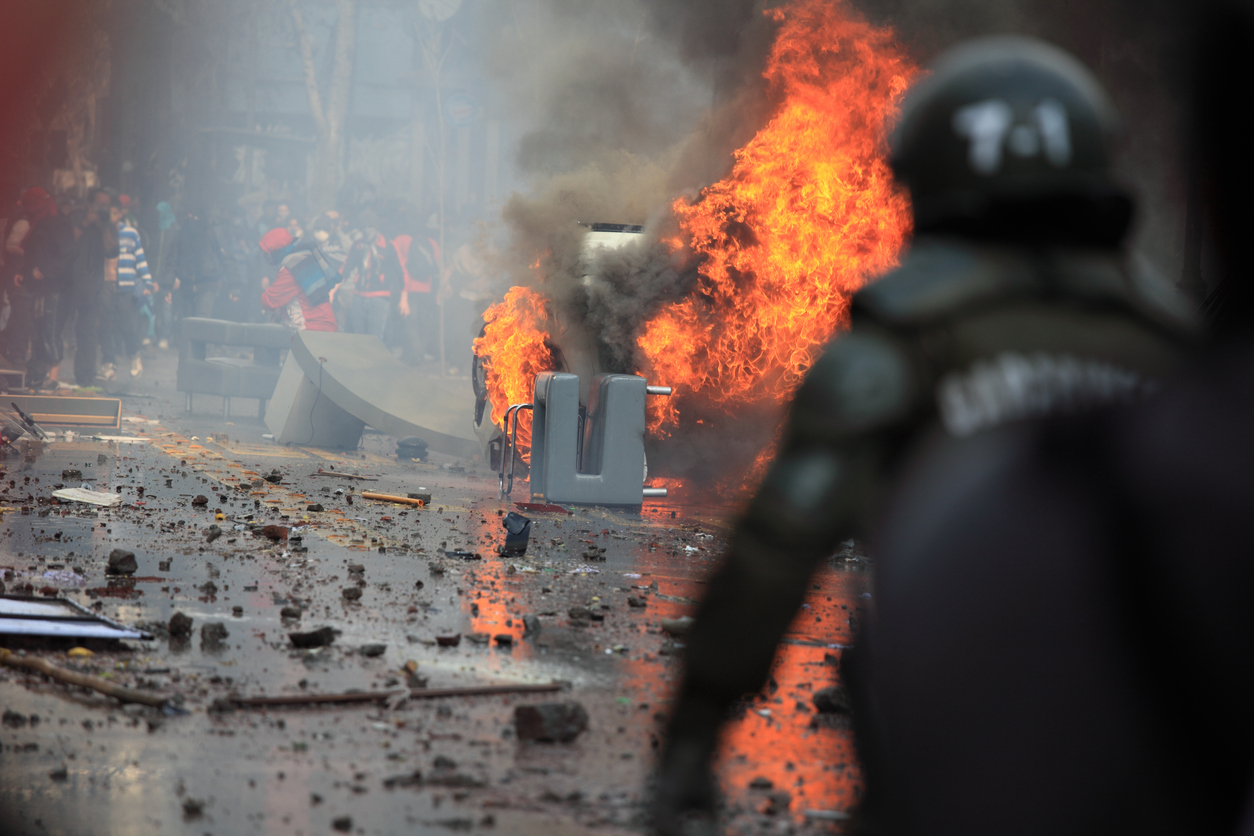
Yesterday, I wrote about my BOMA presentation concerning riot, civil commotion, and political violence insurance in Riot, Civil Commotion, and Political Violence Insurance: What Building Managers Must Know Before the Loss. I then realized I have never written a basic explanation of SRCC coverage and political violence insurance on this blog. These are not everyday coverage topics for many property insurance practitioners, public adjusters, property managers, or policyholders. But they should be.
SRCC stands for “strikes, riots, and civil commotion.” It is insurance shorthand for losses arising from labor unrest, riots, public disorder, looting, vandalism associated with unrest, and civil disturbance. The language sounds old-fashioned because it is. Insurance policies often carry history in their wording. These terms developed because losses caused by crowds, strikes, political unrest, and public disorder do not always look like ordinary fire, theft, or vandalism claims.
A typical commercial property policy is historically written around the idea that a particular covered cause of loss damages a particular property. A fire burns a building. A windstorm damages a roof. A pipe bursts. A thief breaks in. But riots and civil commotion can damage an entire district, shut down access to streets, interrupt tenants, trigger curfews, and create financial losses even when the building itself is not badly damaged.
Many standard commercial property policies may provide some coverage for riot or civil commotion as a covered cause of physical loss. But policyholders should not take too much comfort from that general statement. The important question is not whether the policy uses the word “riot.” The question is whether the policy responds to the full financial harm caused by the unrest.
Traditional property insurance policies may cover broken glass, smoke, fire, or vandalism damage. But what about loss of access? What about a curfew? What about police closing the street for a week? What about tenants who cannot reopen? What about lost rental income, lost percentage rent, extra security, emergency safety board-up, debris removal, or temporary operations? What if the building next door burns and your building is undamaged, but nobody can enter your property because the street is blocked?
Those questions are why SRCC coverage exists as a distinct subject in the insurance marketplace. They are also why policyholders should stop asking only, “Do we have riot coverage?” and start asking, “Walk me through every financial loss we may suffer if civil unrest shuts this property down.”
SRCC coverage can appear in several ways. It may be included in a standard commercial property policy. It may be excluded or limited and then bought back by endorsement. It may be part of a standalone “political violence” policy. It may be tied to terrorism coverage. It may be sublimited, subject to special deductibles, waiting periods, time limits, geographic restrictions, or narrower business interruption language. The actual wording matters.
Political violence insurance is broader than SRCC. Depending on the form, it may include terrorism, sabotage, malicious damage, strikes, riots, civil commotion, insurrection, rebellion, coup d’état, civil war, war, and other politically motivated violence. These policies are often specialty products placed through sophisticated brokers and markets, including the surplus lines and Lloyd’s markets, because the risk can be severe, concentrated, and difficult to model.
Terrorism coverage and political violence coverage are not the same thing. This is worth emphasizing because many commercial insurance applications make terrorism coverage look like the answer to every politically motivated loss. It is not. Terrorism coverage may be important, and lenders often require it. But a riot is not automatically terrorism. A curfew is not automatically terrorism. A protest that shuts down a downtown corridor is not automatically terrorism. Looting following a demonstration is not automatically terrorism.
Terrorism coverage asks whether the event qualifies as terrorism under the policy. SRCC and political violence coverage ask whether strikes, riots, civil commotion, or political violence cause covered physical damage or business interruption. The distinction can determine whether a claim is paid, limited, or denied.
The need for these coverages has become more obvious because civil unrest is no longer a remote issue. Major cities, universities, transportation hubs, government buildings, retail corridors, convention districts, and mixed-use developments can all be exposed. Large political events, international sporting events, labor disputes, controversial court decisions, and geopolitical conflict can increase the risk of disorder. From an insurer’s perspective, SRCC can behave less like a single-building loss and more like a catastrophe affecting many insured properties at once.
Property owners should understand what that means. If insurers are becoming more sophisticated about underwriting civil unrest, policyholders must become more sophisticated about buying coverage for it.
Building owners and property managers should also understand that insurance cannot be separated from leases. Commercial riot losses often become a triangle dispute among the landlord, tenant, and insurance company. The landlord believes the tenant is responsible for storefront glass or tenant improvements. The tenant believes the landlord’s building policy covers the loss. The insurer reads the policy and lease and sees gaps, exclusions, sublimits, or conditions neither side appreciated before the loss.
Before a civil unrest loss, the lease and insurance program should be compared. Who insures the glass? Who insures tenant improvements and betterments? Who insures business personal property? Who insures lost rent? Who is responsible for deductibles? Who controls repairs? Who receives insurance proceeds? Does the tenant’s business interruption coverage support its obligation to pay rent? Does the landlord’s rental income coverage protect the owner if tenants cannot operate?
Simply reviewing a certificate of insurance, commonly referred to as a “COI,” will not answer most of those questions. This is where insurance agents and brokers should add enormous value. A good broker should not merely quote the lowest premium. A good broker should walk the property owner through realistic loss scenarios. If a riot damages the lobby, what happens? If looters break tenant glass, what happens? If police close the street, what happens? If civil authority prevents access for seven days, what happens? If tenants cannot operate and rent is interrupted, what happens?
Political violence insurance may not be necessary for every building. A small suburban office building has a different risk profile from a high-profile downtown retail property, transportation-adjacent development, government-leased building, major mixed-use project, or property located in a city with recurring unrest. But every property owner should at least understand the exposure and know whether the risk is being transferred, retained, limited, or simply ignored.
SRCC and political violence coverage should not be bought while the crowd is outside the building. They should be discussed and negotiated at renewal. They require thought, underwriting information, lease review, and careful attention to exclusions, sublimits, waiting periods, deductibles, business interruption, civil authority coverage, ingress and egress, and definitions.
A riot may begin as a public safety issue. It quickly becomes a business continuity and insurance issue. Without a continuity plan that is practiced and adequate coverage, these civil unrest events become a business survival issue.
Thought For The Day
“The practice of violence, like all action, changes the world, but the most probable change is to a more violent world.”
—Hannah Arendt, On Violence